Inside the Pas Normal Studios Playbook: How Content and Community Drive Commerce
Every technology decision, every content investment, every store activation at Pas Normal Studios, the Danish premium cycling apparel brand, is judged by whether it strengthens the relationship between the brand and the people who wear it. The typical eCommerce metrics come second. Growth, speed, efficiency all serve the relationship, not the other way around. That framing sounds like marketing until you look at how it actually shows up in operational choices. Free weekly rides at flagship stores. A gravel racing team run as a content vehicle. A loyalty program that refuses to reward spend. A digital operating model designed to make the brand more real, not more efficient.
I spent an hour with Sarah Steiger, Chief Digital Officer, and Ida Holmen, Chief Marketing Officer, to understand how the company actually operates. This piece is what I took from the conversation, structured around what other premium DTC brands can actually learn from it.
Steiger stepped into the CDO role in early 2026, having previously led digital as Director. The promotion reflects a wider shift at Pas Normal Studios: the business is doubling down on owned channels. eCommerce moved from a separate commercial function into her remit, alongside IT, front-end and back-end engineering, customer service, and the post-purchase flow. She now leads a team of eleven, including a new Head of eCommerce Growth. As she framed the change: as Director, she spent most of her time on the how. As CDO, she spends more of it on the why.
Contents
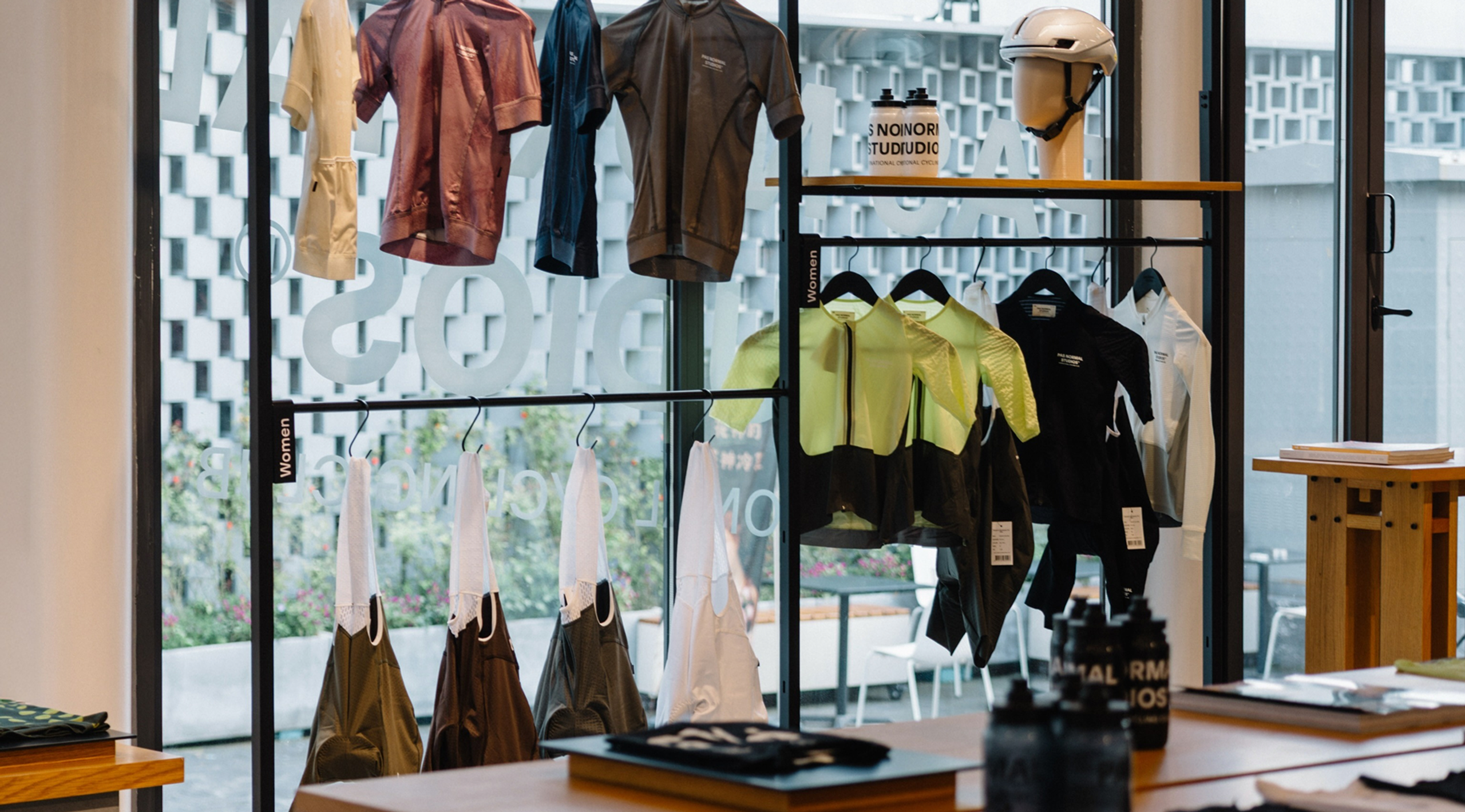
↑ Pas Normal Studios flagship store interior with cycling apparel on display and riders gathered. Source: https://www.instagram.com/p/DcgkaYZCDQD/?img_index=1

How Pas Normal Studios uses retail as a community hub
Pas Normal Studios doesn't treat a store as another sales channel. It treats it as a base for the local cycling scene. Somewhere to start a ride from, get a bike looked at, drink a coffee, meet people.
Most DTC brands opened physical stores to solve the same problem: rising acquisition costs and thinning digital margins. Retail became a fulfillment channel with a nicer facade. Pas Normal Studios opened stores for a different reason, and it shows in how they're used.
The goal for every location was that it had to be a place customers could bike to. Not just visit. Locations get judged on how easily people can arrive on a bike, not on footfall or rent per square metre. That single constraint puts the community ahead of the usual retail maths, and it shapes everything downstream. It also shifts what the store measures. Sales per square foot matters. So does the number of people who show up for a Saturday morning ride and leave without buying anything. Infrastructure is judged on whether people use it. A store that 400 people walk into for a coffee event has done its job, even if nobody buys a thing that day.
Around four rides a week come out of each store. They're free. They're organized by pace group rather than kit brand or bike type. Around them sits a broader program of cultural events. Mechanic workshops. Coffee sessions. Latte art. When the Shanghai store launched an event with Coffee Collective, the Danish roaster PNS works with in-store, around 400 people showed up. Not all of them were cyclists. That's the point.

↑ Coffee and cycling are inseparable. A club ride gathering outside La Marzocco, before anyone has clipped in. Source: Pas Normal Studios — https://pasnormalstudios.com/eu/pages/homegrown-heroes
The model extends beyond PNS-owned retail too. Stockists that carry the brand host their own PNS-branded rides, from weekly local meetups to the annual Midsummer Ride, which draws 200+ riders at partner stores across markets. Community activation isn't gated to the flagships.
Holmen frames the underlying philosophy plainly:
Community has become a marketing buzzword. Everyone is screaming, oh we need to build community. In our view, community is nothing you can buy. It's something that grows organically.
Ida Holmen, Chief Marketing Officer
There's a consequence to that view most brands miss. If community is organic, a brand can host it, but it cannot own it. Pas Normal Studios provides the platform, the coffee, the ride leader, the safety brief. What people talk about on the ride is not their business. This is the difference between building an audience you extract from and building an audience you're accountable to.
For any brand thinking about physical retail as a growth lever, the practical takeaway is that the store's job is to make the community more real, not to make the funnel shorter. Everything else follows from that.

↑ Source: https://steedcycles.com/blogs/steed-cycles/event-recap-pas-normal-studios-resolution-ride
Product detail pages as a conversation with the sales assistant
If retail is the community anchor, the product detail page is where the brand's promise gets tested. In-store, a customer can pick up a jersey, feel the fabric, weigh the material against the price tag, and ask the person behind the counter what happens to the fit at 30 degrees. Online, the PDP has to compress all of that into the 0.9 seconds Steiger estimates the team has before a visitor scrolls to something else.
The move I've seen across premium DTC over the past two years is a shift from studio product photography to video showing the product in motion. Pas Normal Studios has leaned harder in that direction. Close-up on-bike footage of how a jersey moves at speed. How a jacket sits on the shoulders under load. How the light catches the fabric texture. Not glossy campaign film, but material behavior. That's a specific choice, and it's what an in-store conversation actually communicates. Not "this looks nice" but "this will feel right when you're 90 minutes into a ride."
One of the smallest but most effective PDP details PNS gets right is on the very first product image: the model's height and the size they're wearing, printed directly on the shot. It preempts the sizing anxiety that quietly kills conversion on premium apparel PDPs, and it's the kind of detail buyers register even when they don't realize they're registering it.
The other change is technical specification design. PNS added round-shaped indicators to every PDP: breathability, waterproofness, thermal rating, weight, each filled on a scale from 1 to 6. That lets a rider scan the trade-offs at a glance without reading a spec sheet. The information is standardized, comparable across products, and legible in seconds.
For any brand whose product justifies its price through material or craft, this is the right frame. The PDP isn't a spec dump. It's the digital version of the salesperson explaining why a premium jersey is worth its price. We wrote about this pattern in more depth in our guide to building a Shopify product page, and PNS is a good live example of it in the wild.

↑ Pas Normal Studios product page: size guide, crash replacement, complete the look and editorial content in a single flow. Source: Pas Normal Studios — https://pasnormalstudios.com/eu/products/mens-mechanism-jersey-navy
How Pas Normal Studios uses long-form content to drive commerce
Most marketing gets measured on what it returns inside the attribution window. Pas Normal Studios doesn't accept that as the only test. Some of the most important investments the company makes are in long-term brand building and cultural relevance, and those return on a timescale no dashboard is built to see.
In late 2025 Pas Normal Studios released Road to Traka, a 58-minute documentary following the brand's international gravel team through the lead-up to one of Europe's toughest gravel races. It is the brand's first full-length film.
What makes the release notable isn't the film alone. It's the multi-channel narrative PNS built around it. Coverage on social channels started months before the race. Live storytelling ran during the event. The documentary landed afterwards as the payoff. The film was the anchor, not the whole story. That's what makes long-form content pay off: the surrounding channels do the work of turning it into a moment.
Ask most eCommerce teams to justify a 58-minute film and they can't. The dashboard doesn't reward it. Attribution windows don't survive it. The PNS team doesn't hide from that:
Road to Traka is not made to convert sales next week. This type of content is to bring the audience closer to the brand. It's harder to measure than a low-funnel ad, but equally important. Everyone can sell products. For us, Pas Normal is so much more than that.
Ida Holmen, Chief Marketing Officer
What makes the investment work isn't clever attribution modeling. It's that the film was designed from the start to double as a community program. In-store screenings ran in key cities. Riders from the race team turned up and stayed for Q&A. That converted a single content asset into a multi-city retail activation, into member-only invitations, into organic social content, into press coverage from cycling media that would never have covered a product launch.
This is the model brands like Aether Apparel have run for years with their journal and Restless Spirits series. It works when the brand has enough cultural gravity to make a story worth telling, and enough retail and community surface area to give the story somewhere to land. Without both, long-form content is a vanity expense.

↑ Traka Document available on Youtube: https://www.youtube.com/watch?v=97uqoQAMqLM
Inside Pas Normal Studios' loyalty program: the International Cycling Club
Nearly every loyalty program runs on the same assumption: the more you spend, the more you deserve. Pas Normal Studios rejects it outright. Status in the club comes from taking part, not from what you have paid.
Pas Normal Studios' loyalty program is called the International Cycling Club. Membership is free. During signup, new members answer a single question about how they ride: training and racing, gravel and exploration, casual riding and commuting, or off-bike training. That answer segments the entire member base from day one, without a single tracking pixel.

↑ PNS International Cycling Club registration. Three questions, and the card picks up the rider's name, country and riding style.
That first-party data capture pattern is one I wrote about in the eCommerce loyalty piece. It's the highest-value data most brands never ask for.
But what's more interesting about ICC is the philosophy it refuses. Standard loyalty programs run on point accumulation. Spend more, earn more, unlock more. PNS explicitly rejects this frame:
It's not a buy ten jerseys, get one free. It's centred around experiencing the brand and cycling, less around the purchasing part. And you cannot buy your status in that club. Every rider in our community is equally important.
Sarah Steiger, Chief Digital Officer
That's a strong position, and it has consequences. It rules out tier structures based on spend. It rules out kilometer-based tiers too, because a passionate cyclist might only ride 50k as a max. What it leaves is challenges. The January Resolution asks members to ride 500 kilometres in a month. International Women's Day is a Strava challenge. Midsummer Challenge is a single 200-kilometre ride. Complete them and you enter draws or unlock content. Anyone can join. Spending more doesn't unlock more access.
There's a small shopper-facing benefit worth naming, because it's the kind of thing loyalty designers overlook. ICC members get early access to the archive sale a few days before it opens to the public. It's not a discount, and it's not a status tier. It's a quiet reward that says: you're part of the club, and the club sees the good stuff first.
Layered on top is a store-specific event program: dash races, epic rides, plus-one events, mechanic clinics, latte art sessions. The rule Holmen described is that even a ride ends with something off the bike, pizza, coffee, drinks, or in July, gathering to watch a Tour de France stage together, because the social part after matters as much as the social part during.
For any brand thinking about loyalty, the useful comparison is this: Represent's Prestige 2.0 rewards engagement through missions and lets high-value customers unlock money-can't-buy items. Aether's Insider is a paid membership with a concierge and unlocked benefits at spend thresholds. PNS runs a community-first model where the reward is access to the culture. All three work. The right one depends on whether your brand is a product people buy or a lifestyle they join.
How Pas Normal Studios manages content localization across markets
Pas Normal Studios sells internationally. Every market has its own cycling culture, its own weather, its own season. What resonates in Copenhagen doesn't automatically resonate in Sydney or Singapore. The tension between global brand consistency and local relevance is the operational challenge of every premium DTC scaling internationally.
Holmen's framing for entering a new market is instructive:
When we enter a market, we're entering someone else's house. We team up and become friends with people within that space. We follow the rules, both legal and the social codes. Sometimes you need to tweak your messaging, but you also need consistency around the globe. People need to recognize the brand.
Ida Holmen, Chief Marketing Officer
In practice, on the website, this is what Sarah calls "localization light." Different homepage heroes and banners per market, driven by both commercial focus and seasonality. Sarah gave a concrete example: when PNS launches a winter product, engaged Australian customers actively write in to point out that it's summer where they are and the winter campaign on the homepage feels off. That customer feedback is what keeps the localization tuning honest.
The move that goes beyond standard localization is the reverse flow. PNS deliberately amplifies content produced in one market globally. A ride in Japan gets shown in Denmark. A gravel story from Colorado shows up in Copenhagen. The logic is that cyclists everywhere want to see how the sport is lived elsewhere. This flips the usual model where global brands localize down. PNS localizes across.
Why Pas Normal Studios moved to headless Shopify
The infrastructure that lets all of this work is a composable stack. PNS moved off native Shopify to a headless setup with Sanity as the CMS. The reason wasn't performance. It was control.
The old setup was native Shopify with a home-built PIM and service layer sitting on top. Over time that middle layer grew into what Steiger called a bottleneck monster. Sarah listed the specific problems that pushed the decision: every change to the site needed a developer, iteration was slow, and the team wanted the flexibility to reshape the customer journey and how products are presented without being blocked by engineering capacity. For a brand-heavy site where the experience is a real part of the product, that dependency was too expensive.
Post-migration, PNS built its own page-building and content operations layer using Sanity – the content operating platform, giving full flexibility to build pages, redirect traffic, and reshape the customer journey without a developer in the loop.
The pattern PNS describes is one we keep seeing at the premium end of the market. Brands don't go headless because they need faster page loads. They go headless for full control over their integrations and UX/UI and how they manage content on the global scale. Native platforms make trade-offs on all three. We wrote about the wider comparison, including where Liquid is now catching up and where headless still wins, in the state of Shopify: headless vs Liquid.
Sarah gave a small example about interaction feedback that captures why this matters:
We had to put in a delay because our website was too fast. It loaded so fast people didn't realize things were happening, and it had a negative effect on conversion. So we introduced reactions, adding-to-cart animations, loading states.
Sarah Steiger, Chief Digital Officer
eCommerce optimization has a human ceiling. If people can't see the interaction, it impacts conversion. Every performance win eventually collides with perception, and the right answer is not more speed.
The eCommerce metrics Pas Normal Studios' CDO watches
When I asked which metrics matter most to the digital team, Sarah pulled up what she calls her "holy bible":
Net revenue. Conversion rate. Bounce rate by page. Then, depending on where the bounces are happening, launch-versus-last-year comparisons and basket size.
That's not surprising in itself. What's more interesting is what isn't on the list. No traffic obsession. No cost-per-acquisition dashboard as the daily anchor. No attribution-modeled ROAS as the north star. Those metrics matter for paid media decisions, but they're not what the CDO uses to run the ship.
For premium DTC brands, that's the right instinct. Traffic without conversion is a marketing problem, not a product problem. And ROAS without a full-funnel picture flatters short-term paid buying while starving the brand of the top-of-funnel investment that keeps organic acquisition alive. The metrics Sarah watches are the ones that tell her whether the customer is finding what they want, and whether the launch strategy is working. Everything else is downstream.
AI in eCommerce
Every brand is being asked what its AI strategy is. Most give a version of "we're exploring." Pas Normal Studios has drawn the line more explicitly.
AI runs in the parts of the stack the customer never sees. Code generation. Technical SEO. Meta fields, metadata, product tag hygiene. The team has removed a large human portion of writing these, and shipped features faster on the back end. Consumer-facing creative is the part they deliberately do not automate. Sarah tried an AI copywriting project using product information and pulled it. The output was, in her words, far off from the brand.
The reasoning goes deeper than aesthetic preference:
We are very heavy on brand. To showcase our product with people who ride and are inspiring, dedicated, passionate cyclists is essential in our storytelling on site.
Sarah Steiger, Chief Digital Officer
For a brand whose entire proposition is real cyclists on real bikes on real roads, an AI-generated model walking down an AI runway is counter-brand. It doesn't matter how good the output looks. Cyclists in AI-generated ads would contradict what PNS spends every other dollar making real.
There's a funny inversion this has created. PNS occasionally gets comments on ads accusing them of using AI. In every case the person in the ad is a real ambassador who lives in a real city and rides a real number of kilometres a week. As AI-generated imagery floods the internet, the ability to prove your content is human is becoming its own brand asset.
The one place AI is being explored on the visual side is pre-sale imagery for wholesale buyers, where product photography isn't ready. Serving a wholesale buyer a synthetic mockup is different, in the team's view, from serving that same image to a consumer. It's a distinction most brands blur, and I think PNS is right to hold it.
For premium DTC brands generally, the useful frame here is that AI is a back-office productivity tool by default, and a consumer-facing content tool only if you can afford to look generic. If the brand is expensive and the price is justified by craft, storytelling, and heritage, AI-generated creative undermines the premium. If the brand is fast-fashion or commodity, AI is table stakes.
What didn't pay off: lessons from Pas Normal Studios
Every interview trends toward the wins. The more useful question is what didn't work.
The biggest sunk cost in PNS's digital operation over the past year was a translations project. The goal was to use AI to translate English copy into other markets while staying on point on brand tone. It didn't work. The AI translated the words. It couldn't translate the voice. There were, as Steiger put it, a lot of crashes and fails.
This is the failure mode every brand-led team should expect. Translation quality has improved dramatically, but "correct" and "on-brand" are different bars. A luxury cycling apparel brand has a specific tone: understated, technical, culturally aware, occasionally dry. That tone lives in word choices, sentence rhythm, and cultural references that language models normalize away. The lesson for other brands: budget for human copywriters or transcreators in every market where the voice matters, and treat AI as a first draft, not a shipped output.
The wider context is that PNS is running the paid media playbook from a low base, because the company was built on community and hasn't historically spent much on performance channels. That means the current mix is genuinely experimental. The team is testing formats, channels, and top-of-funnel investment, and it's too early to say what's working. Steiger described this as part of the shift from startup to scale-up, which every DTC brand hits somewhere between $30M and $100M revenue. Community-led growth got them here. Paid media, top of funnel, and CRM sophistication get them to the next order of magnitude.
The cultural piece that makes all of this survivable is what the leadership team is trying to embed: a fail-and-learn culture, where breaking things is treated as evidence of trying rather than as evidence of incompetence. That's easier to say than to build. But it's the only frame under which a full-length-film investment or an AI translation project failure can be treated as data instead of blame.
The one thing to do this year
I closed by asking Steiger and Holmen what they would tell a peer at another premium brand who wanted to start turning content into commerce more deliberately. The answer wasn't about tech. It wasn't about content. It was about listening:
The customer you would like to have and the customer you actually have are often different. I've been in a lot of companies where we're painting up a persona that doesn't exist. Consumer insight, testing, and learning around that has been absolutely crucial to finding the balance between brand and eCommerce.
Sarah Steiger, Chief Digital Officer
This is the single most underrated capability in premium DTC. Brand teams tend to design for aspiration. Digital teams tend to design for data. Neither is the customer as they actually are. PNS runs post-purchase surveys, re-engagement surveys, and qualitative focus groups to keep the picture honest. It's unglamorous work, but it's what stops a brand from drifting into a fantasy version of its own audience.
Behind the films, the community rides, the flagship stores in Copenhagen, Munich, San Francisco, and Shanghai, is a discipline of asking real customers what they actually think and using the answers to shape the next thing. Content and community build the brand. Consumer insight keeps the commerce honest. If the last few years of DTC taught anything, it's that no amount of brand equity survives losing touch with the person actually clicking buy.


