What is eCommerce Loyalty? Tactics and Examples
Customer acquisition costs for ecommerce brands have climbed roughly 40% since 2023. It gets worse every year as paid media costs climb across Meta, Google, and TikTok. That math is why retention keeps moving up the priority list. But most brands still treat loyalty as a program, not a strategy. Points, tiers, birthday discounts. The real question is broader: what does it actually take to make customers come back?
eCommerce loyalty is the tendency of online shoppers to repeatedly choose one brand over competitors. It goes beyond discount codes and points programs. Real loyalty happens when customers buy from you because they want to, not because you bribed them.
Most ecommerce brands think loyalty means launching a points program, but it doesn’t. Loyalty is the outcome. A program is just one tool to get there. Some of the strongest loyalty in eCommerce exists without any formal program at all.
This article covers what eCommerce loyalty actually means, why it matters financially, the different forms it takes, tactics that work with real examples, and deep dives into brands doing loyalty in distinctive ways. It includes insights from Conor Jones, eCommerce & Technology Strategist at Vervaunt, who has spent the last several years designing loyalty programs for brands including Represent. Full disclosure: Conor contributed practitioner insights to this article.
Contents
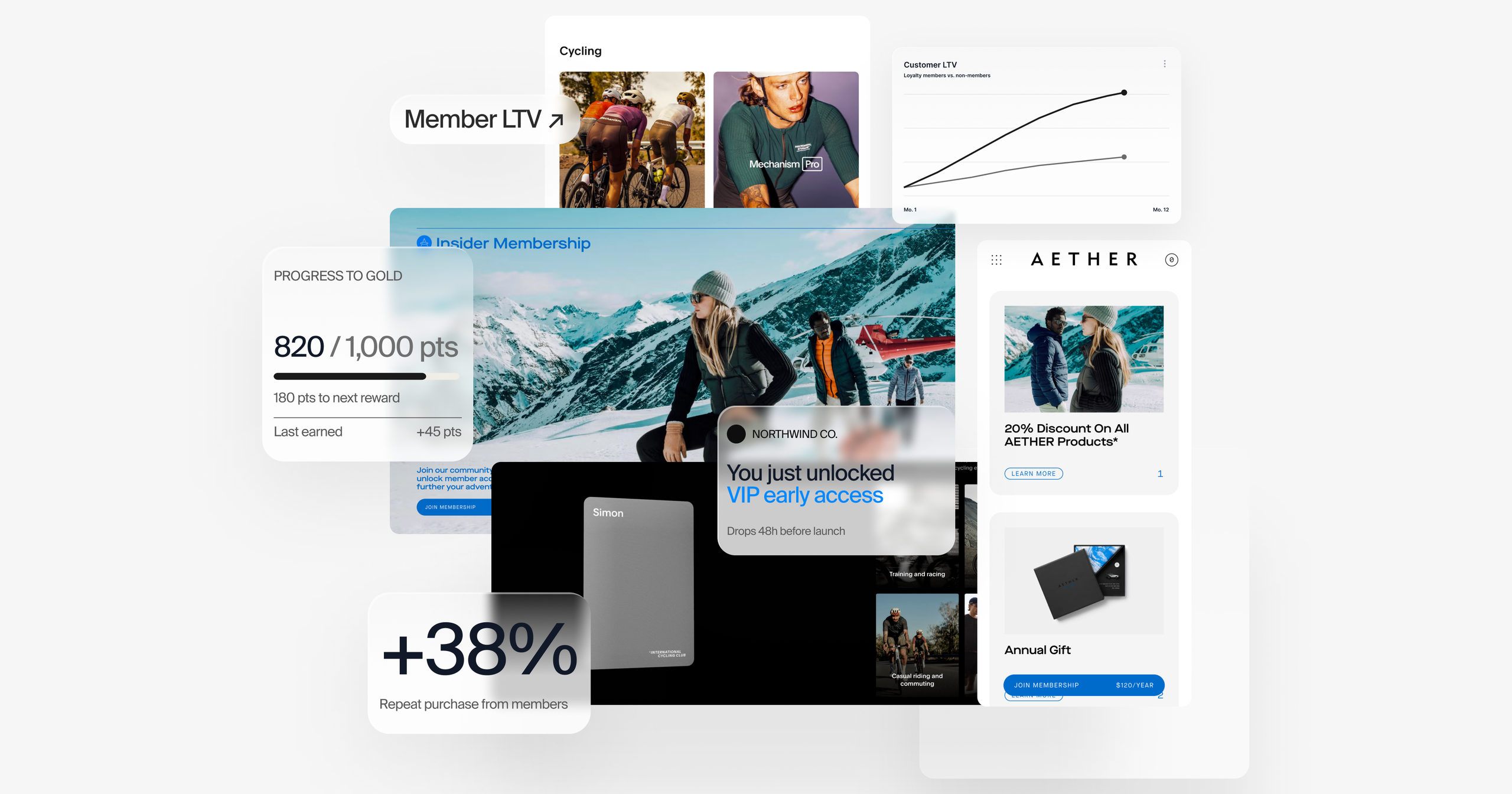

What is eCommerce Loyalty?
eCommerce loyalty is the gap between someone buying from you because you’re convenient, and someone buying because they genuinely want to be part of what you’re building.
Represent is a good example. A customer buying 247 (their activewear line) isn’t just shopping for gym clothes. They’re attending Represent runs in London, Manchester, and LA. They’re going into flagship stores for coffee and chatting with staff. They’re following the founders on YouTube. That’s not transactional behavior. That’s community.
There’s an important distinction between having a loyalty program and having loyalty. It’s easy enough to install a Loyalty solution and switch it on. But without deeper relationship-building, you’re essentially just creating another discounting mechanism.
Two kinds of loyalty exist, and the difference matters for how you design your approach.
Transactional loyalty is driven by habit, convenience, or incentives. The customer keeps buying because it’s easy or cheap. Maybe you offer free shipping, or your site saved their payment details, or they’re earning points toward a reward. This loyalty is fragile. Switch the incentive, and they leave.
Emotional loyalty is driven by genuine brand affinity. The customer identifies with what you stand for. They’d pay full price. They’d recommend you unprompted. They buy items from a brand because they want to join the tribe, not just own the product. This loyalty survives price increases, shipping delays, and competitor promotions.
Cycling shows this clearly. Brands like Pas Normal Studios and Rapha build communities where wearing the kit signals belonging. You don’t just buy a jersey. You join a group that rides together every Saturday morning.
Building loyalty in eCommerce is harder than in offline retail. There’s no face-to-face interaction. No shop owner who remembers your name. Competitors are one click away. Price comparison takes seconds. Every touchpoint has to earn the customer’s return.
Why eCommerce Loyalty Matters
Acquisition costs keep climbing
Customer acquisition costs are rising year over year across every major ad platform. The privacy changes accelerated this. Third-party cookie tracking is disappearing. iOS changes made it harder to fingerprint and track customers. Brands that relied heavily on paid acquisition are now paying more for less precise targeting.
The ROI data backs up the case for retention. According to Antavo’s Global Customer Loyalty Report, loyalty programs generate 4.8x to 5.3x more revenue than they cost on average. 83% of program owners who measured ROI reported a positive return.
Loyalty as a first-party data strategy
With tracking becoming harder, loyalty programs are the primary way to get customers to voluntarily share their data. Even without a formal loyalty program, building an account area where customers share their gender, age, product interests, and sizing lets you personalize every email and recommendation without cookies.
If a customer goes to Represent tomorrow and the brand has no tracking pixels, that customer can still tell them they’re male, wear a size medium, are interested in activewear, and wear a size 9 shoe. Every email after that is personalized to what the customer chose to share. No cookies required.
The revenue math
Loyal customers punch above their weight. Repeat buyers make up a small share of most customer bases but account for a disproportionate share of revenue. Bain & Company found that a 5% increase in customer retention can boost profits by 25% or more. The pattern shows up everywhere you look.
Brands running structured loyalty programs consistently see their members spend multiples more than guest shoppers.
Types of eCommerce Loyalty Programs
Not all loyalty looks the same. Most successful programs blend two or three of these types. The mistake is thinking you have to pick just one.
Points-based programs
Customers earn points per dollar, and redeem them for discounts or free products. This is the most common model. Simple mechanics, easy to understand. The risk is that the math gets confusing. Some brands set 100 points equal to one pound. Others set one pound equal to one point. Others use 10 or 20. When a customer shops across multiple brands, each with different ratios, the value becomes unclear.
Bershka takes a different approach. Instead of points, they use a cash-back model where you have a tangible pound, dollar, or euro value attached to your account. This can be more effective because the value feels real, not abstract.
Tiered programs
Tiers give customers something to aspire to. Each level unlocks better perks, which incentivize higher spend and deeper engagement. The psychological pull of "almost reaching the next tier" keeps customers coming back.
But tiers fail when the thresholds are set incorrectly. A common problem: a brand with an average order value of 70 to 80 pounds sets tier jumps that require 16 to 18 purchases to reach the next level. Customers stagnate and stop trying. The fix is adding intermediate tiers and making sure there’s enough in between to keep people engaged, even if it’s not purchasing. Answering questions, providing first-party data, sharing on socials or completing a mission can all contribute.
Tiers also fail at the top. A customer who has made 20 purchases is loyal because they value the product. If the top-tier benefits are still just 15% off and free shipping, you’re not giving them a reason to stay engaged.
Paid memberships
Customers pay upfront for premium benefits. Rapha’s RCC charges 70 pounds per year for a global cycling community with 22 clubhouses. Bandit Running charges around 120 pounds and gives you a gift card, a pair of socks, and partner discounts immediately.
Aether Apparel runs a hybrid model. Anyone can buy their Insider membership for $120 per year, but high spenders get complimentary access automatically. That dual path lets the program serve both committed fans and top-tier customers.
Paid memberships require established brand affinity first. You need customers who already want to belong before you ask them to pay for it.
Community models
The hardest type to build. You can’t flick a switch and have a community overnight. Represent built theirs over years of consistent effort: unofficial Facebook groups, Discord servers, WhatsApp groups where members compare points, discuss tiers, and share what they’re wearing.
Djerf Avenue built something called Angel’s Avenue, a Pinterest-style platform within their site where customers post outfits, like and comment on each other’s looks. No incentive to post. People do it because they want to.
That’s what makes community models so powerful and so difficult. Getting a first-time buyer to create an account, join a community platform, and start contributing requires a level of brand affinity that takes years to earn.
Pas Normal Studios takes a different route. Their International Cycling Club runs weekly group rides from flagship stores in Copenhagen, Munich, Mallorca, and San Francisco. Each city has its own Strava club. They send Destination Everywhere vans to events and races around the world. As founder Peter Lange puts it, apparel is the product, but the cycling club is the community. You don’t need to buy anything to show up for a Saturday ride.
Proven eCommerce Loyalty Tactics
Missions and gamification
Missions are engagement-based challenges where customers don’t need to spend money to earn points. Represent’s Prestige 2.0 made missions the hero feature. Before the rebuild, their "missions" were basic: follow on Instagram, like a page on Facebook. Now they include things like browsing a new category, watching a video, downloading the app, visiting a store, or shopping cross-category (buying both a 247 product and a Members Club product in the same period).
Good mission design borrows from gaming. Challenges reset after a set period. Visit a store this week, earn points, and the mission resets so you can do it again next week. This avoids the common problem where you complete a mission once and it’s done forever.
Game-based rewards increase engagement significantly over and above value-only rewards, especially when users are close to earning the next reward. The key is making it feel like a game, not a chore.
Exclusivity over discounts
Brands like Represent, Kith, Salomon, Hugo Boss, North Face, and On Running are all leaning into member-exclusive products and experiences rather than bigger discounts. Kith releases tier-specific sneaker colorways. Salomon runs members-only colorways and in-store members days.
This approach is growing, but it will get saturated. The next step is going beyond fashion exclusives into things money can’t buy. The next step is going beyond fashion exclusives into things money can’t buy. Consider categories outside your core product set. A fashion brand might explore homeware, lifestyle accessories, or limited one-of-one pieces that members can bid on with points
For premium brands, discounting is risky because it dilutes the brand. Self-Portrait solved this by gating their markdown sale behind membership. The first markdown required mailing list signup. The second required account creation. That gates the best deals behind membership without cheapening the brand perception.
First-party data capture
The most effective approach is asking one simple question after signup: what types of products are you interested in? No incentive needed. When the question is placed naturally in the account setup flow, a meaningful percentage of customers will answer it voluntarily. That preference data feeds directly into email personalization and segment-based testing without any reliance on tracking pixels.
Pas Normal Studios does this well. During ICC membership signup, they ask for your preferred riding style (training and racing, gravel and exploration, casual riding and commuting, or off-bike training) and frame it as enriching your experience with relevant local events and rides. That single question segments their entire member base by activity type from day one

Cross-category incentives
A customer acquired through activewear might never shop a brand’s mainline collection on their own. Loyalty can bridge that gap. Represent does this with 247 and Members Club. A customer who only buys 247 activewear gets double or triple points on their first mainline order. It nudges cross-category behavior without discounting.
This works for any brand with multiple product lines. The loyalty program becomes a tool for expanding basket composition, not just increasing purchase frequency.
In-store NFC check-in
Most loyalty wallet passes are used at checkout. That means customers "check in" when they’re already buying. The gap is the store visit where someone walks in, browses, and leaves without purchasing.
The next step is NFC tap-in at the door, not the counter. Brands are beginning to explore NFC wallet passes and physical membership cards with embedded chips. A customer taps when they enter the store. The system logs which location, which device, and when. If that customer doesn't purchase, the brand can trigger a follow-up email within minutes. Some brands are already using QR codes for in-store check-ins but want to take this further. Piing, launching in June 2026, is one platform building this capability
That turns a zero-revenue store visit into a data point and a re-engagement trigger. Hugo Boss does something similar with their XP program, where NFC cubes in stores let customers tap to check in and earn tokens. Hugo Boss also uses RFID in changing rooms to track which products a customer tried on.
Points redemption beyond discounts
The "too many points" problem is real. Represent’s VIP customers had tens of thousands of points and no way to use them. Their wardrobes were full. They didn’t need another hoodie at 20% off.
Prestige 2.0 introduced new redemption options: exclusive product drops, "artifacts" (one-of-one items like a personalized guitar on display in-store that members can bid on with points), and a point-sharing system where members can transfer points to friends to help them climb tiers.
From a finance perspective, this also solves a balance sheet problem. Unredeemed points sit as liability. New redemption options help customers spend down their balances, which reduces that liability while keeping them engaged.
eCommerce Loyalty in Practice
Represent: From Pound-for-a-Point to Prestige 2.0
Represent started in 2011 when brothers George and Michael Heaton screen-printed 20 box-logo tees in Manchester. By 2023, revenues hit 80.8 million pounds. Their loyalty program, Prestige, has been running since 2017 or 2018, making them pioneers in DTC fashion loyalty at a time when programs were mainly associated with Selfridges, Debenhams, or Nando’s.
The original Prestige was simple: spend a pound, get a point, redeem against discounts. According to Ricky, head of ecom at Represent, that basic program was the engine for the brand’s organic growth. Members had a shared language (comparing points, discussing tiers) that snowballed into unofficial Facebook groups, Discord servers, and community threads.
By 2024, three problems drove the rebuild. VIP customers were sitting on tens of thousands of unredeemable points with wardrobes already full. Tier thresholds were set too high, causing customers to stagnate. And the brand had opened physical stores with weekly community events, but there was no link between those in-person experiences and the loyalty program.
Conor Jones, who worked on the Prestige 2.0 project with Vervaunt, described the approach:
"A good indicator of if loyalty is working is when you’re actually seeing customers consistently move through the tiers and they aren’t kind of stuck in one place."
Conor Jones, Vervaunt
Prestige 2.0 addressed each problem. The team added a tier between the entry level and second step (set at 1.5x the average order value) to reduce the barrier. Missions replaced the basic social follows with engagement challenges: attending events, shopping cross-category, visiting stores, downloading the app. In-store NFC check-in connected the physical and digital experiences. New redemption options (exclusive products, artifacts, point sharing) gave VIPs reasons to spend their balances.
The tech stack moved from LoyaltyLion to Antavo. Early results: a Prestige-exclusive graphic tee limited to 300 units sold out organically. Loyalty members are 3.5x more valuable than guests, purchase 3.4x more often, and 19.6% of total revenues come from Prestige members.
Aether Apparel: Paid Membership Built Entirely Custom
Aether Apparel’s Insider membership costs $120 per year and gives members 20% off everything, free 2-day shipping, early access to new collections and sales, and a dedicated concierge. But the more interesting mechanic is how they handle high spenders. Spend more than $3,000 in a year and you get the next year’s membership free. Cross $15,000 lifetime and it becomes permanent. They don’t advertise this publicly. It just happens.
The program was built entirely custom, with no loyalty platform. (Disclosure: Commerce-UI built Aether’s membership implementation.) A subscription tool handles the recurring annual payment. Everything else, the membership logic, the spend-based complimentary tiers, and the POS integration, was built from scratch. The 20% Insider discount works identically online and in-store.
Aether also uses a wallet pass (Novel) that members add to their phone. It serves as their in-store Insider ID and doubles as a push notification channel. That gives Aether a direct line to their most valuable customers without relying on email open rates. Members get early access to moto trips, rallies, and brand events, some free and some paid, before they’re opened to the public. The concierge service reinforces the premium feel. One dedicated contact handles sizing, orders, and event invitations.

Hugo Boss XP: NFC, Blockchain, and Invisible Web3
Hugo Boss XP was built on the Polygon PoS blockchain. It replaces traditional points with collectible digital tokens. Customers tap their phone against NFC cubes in physical stores to check in. Each check-in earns a "Frequent Visitor" token. Purchases, brand events, and Roblox engagement earn additional tokens that function like video game achievements, unlocking access to exclusive products and experiences.
What sets Hugo Boss apart is the omnichannel integration. All of those touchpoints feed into one unified customer profile. Sales associates see loyalty data on tablets for personalized in-store service. Hugo Boss also uses RFID in changing rooms, so they know exactly which products a customer tried on.
Customers never need to know about blockchain. The technology is invisible. They just see tokens in their app that unlock things. According to their MarCom Awards case study Hugo Boss has seen a 9% increase in new member registrations, 22% rise in member net sales, and 125% uplift in app downloads.
Kith: Access Over Discounts
Kith’s loyalty program runs on exclusivity, not discounts. Three tiers (Molecule, Elevation, Vitality) at 0, 2,000, and 10,000 points. You earn 2 points per dollar on Kith-branded items and 1 point on third-party brands. Points never expire.
Higher tiers don’t unlock bigger coupons. Vitality members get exclusive access to sneaker collaborations, Kith Vault re-releases, skip-the-line at flagship stores, and made-to-order products with roughly six-month lead times. The most creative mechanic is tier-specific product colorways. The Clarks Originals Wallabee collaboration released in Molecule, Elevation, and Vitality hues, where each tier can only access their color and below.
Self-Portrait: Quiet Luxury Loyalty
Self-Portrait’s program, which is powered by LoyaltyLion, is deliberately minimal. No points. No missions. Just spend thresholds with a fixed discount per tier, around 10 to 15% off at the top level. For a quiet luxury brand, a flashy points program would feel off-brand.
Where Self-Portrait gets interesting is in data capture. They gate their biannual markdown sale behind membership, and a double-digit percentage of those new signups voluntarily provided preference data with zero incentive.
Self-Portrait also uses Klevu’s AI Discovery Suite for search behavior, Klaviyo for behavioral flows, and Harper Concierge for at-home styling where a stylist delivers pieces, stays for a fitting, handles payment, and takes returns. That generates rich preference data that feeds back into personalization.
Loyalty Tech Stack: Platforms and What to Look For
The loyalty platform market splits into two tiers. The mid-market includes Rivo, Yotpo and Smile.io. These are products are relatively affordable, and tend to work well for brands in the mid-market range
The enterprise tier includes Antavo, Talon.One, and LoyaltyLion. These offer the customization depth needed for complex programs (missions, point sharing, sub-community groups, advanced omnichannel POS, multi-currency, translations, granular reporting). Bubble House is an emerging option that sits in between: mid-market pricing with functionality closer to enterprise. But they’re still relatively new.
Represent moved to Antavo because they needed missions capability, POS integration for omnichannel, multi-currency support, translation support, reporting granularity, and custom reward types like point sharing and community groups.
On migrations: if you’re not changing the front end or design, moving between vendors is not a huge technical lift. Most vendors can ingest existing tiers and point balances. The bigger challenge is communication. Making it clear to customers what’s changing, walking VIPs through the new experience in person, and ensuring no one feels like they’ve lost status. Represent handled this with an in-store VIP launch event, an on-site walkthrough for first logins, and a change log so members could track rollouts.
| Platform | Tier | Pricing | Missions | Multi-currency | Omnichannel POS | Multi-platform | Multilingual | Best for |
|---|---|---|---|---|---|---|---|---|
| Rivo | Mid-market | Free (200 orders), Scale $49/mo, Plus $499/mo | No | Limited | Shopify POS only | Shopify only | No | Shopify-only brands wanting paid memberships + loyalty at low cost |
| Smile.io | Mid-market | Free (200 orders), Starter $49/mo, Growth $199/mo, Plus $999/mo | No | Limited (% discounts only) | Shopify POS only | Shopify, BigCommerce, Wix | Growth+ plans | Simple points + tiers, quick launch, beginner-friendly |
| LoyaltyLion | Enterprise | From $159/mo to $699/mo + enterprise custom | Custom actions only | Yes | Shopify POS only | Shopify, BigCommerce, Magento | Yes (130+ languages) | Enterprise and Mid-market brands needing analytics depth + multilingual |
| Yotpo | Mid-market | Free (100 orders), Pro $199/mo, Premium $799/mo | No | Supported (limitations noted) | Shopify POS only | Shopify, SFCC, BigCommerce, Magento | Higher plans | Multi-platform brands wanting reviews + loyalty in one vendor |
| Antavo | Enterprise | Custom pricing (requires sales call) | Yes (badges, challenges, quizzes) | Yes | Advanced (QR, mobile pass, Store Assistant) | Platform-agnostic | Yes | Complex omnichannel programs with missions, POS, and custom logic |
| Talon.One | Enterprise | Usage-based, custom quotes (being acquired by Adyen) | Yes (challenges, leaderboards, milestones) | Yes (any currency + multi-wallet) | Full omnichannel | Platform-agnostic | Yes | Enterprise brands needing promotions + loyalty engine with API-first flexibility |
| Bubblehouse | Hybrid | Custom pricing (white-glove service, mid-market price point) | Yes (achievements, quizzes, voting, seasonal) | Yes | Any POS + AI receipt upload | 15+ platforms | Yes | Enterprise features at mid-market pricing with hands-on support |
Pricing as of mid-2025/early 2026. Enterprise platforms require sales conversations. "Limited" means the feature exists but with known constraints. Yotpo discontinued email/SMS in December 2025. Talon. One acquisition by Adyen pending regulatory approval.
How to Measure eCommerce Loyalty
Most practitioners recommend giving a loyalty program at least 12 months before holding it accountable for hard metrics. You need a full trading year to measure the compounding impact, especially on lifetime value. You’ll see early signals (account signups, redemption rates) within the first 90 days, but the real picture takes longer.
Two things tell you if loyalty is actually working. First, purchase data. Look at repeat purchase rate, and specifically the percentage of first-time buyers who come back for a second purchase. Second, tier progression. Are customers consistently moving through tiers, or are they stagnating?
The core metrics to track monthly:
Repeat purchase rate
The percentage of customers who come back for another order. The average ecommerce repeat rate is around 28% according to Shopify, though this varies significantly by product category.
Account signups
How many people are you getting into the program? This measures the effectiveness of your signposting and onboarding.
First-party data capture uplift
How much additional customer data (preferences, sizing, interests) are you collecting through the loyalty program versus without it?
Customer lifetime value
How much a customer is worth over their entire relationship. This takes the longest to compound, which is why 12 months is the minimum measurement window. Represent’s members show 3.5x higher LTV than guests.
Tier progression velocity
How quickly customers move between tiers. If most members are stuck at the base level, your thresholds are too high or your mid-tier benefits aren’t compelling enough.
Redemption rates
How often do customers actually use their rewards? Low redemption signals that your rewards aren’t relevant or that the process is too complex.
Online-to-store conversion
Are loyalty mechanics driving customers who previously only shopped online to visit physical stores? Shopify now makes this data accessible quickly.
An important distinction here is rewarding loyalty vs. rewarding spend
A customer who orders 10 times at 100 pounds each and a customer who makes one purchase at 3,000 pounds are very different. One is genuinely loyal. The other made a big one-time buy. If your tier structure lets a single purchase reach the top tier, you’re rewarding spend, not loyalty.
How to Start if You Have No Loyalty Program
Look at the customer data before building anything. Purchase frequency, lifetime value distribution, first-to-second purchase conversion rates, and repurchase speed. These numbers tell you whether loyalty will solve a real problem or just add complexity.
After the data review, run customer surveys. Engage customers who’ve purchased in the last six months and ask what they’d want from a loyalty program. Number one is always discounts. Number two is always free shipping. But the answers after those first two are where it gets interesting: product exclusives, money-can’t-buy items, homeware, early access.
From there, pick a platform that matches your scale and complexity needs. You can start with Rivo or Smile.io. Brands with more complex requirements, like multi-currency, custom reward logic, or deep POS integration, may need an enterprise platform like Antavo, Talon.One, LoyaltyLion or Bubble House.
Start simple and iterate. Represent’s original program was basic for five years before they rebuilt it. That basic version still drove community growth and established the loyalty behavior. You don’t need to launch with six tiers, missions, and NFC check-in. You need to launch with something that works and improve it over time.
Conclusion
The brands doing loyalty well treat their program as a relationship-building tool, not a discounting mechanism. They use loyalty to capture first-party data that makes every other marketing channel more effective. And they iterate constantly.
Your next step: look at your customer data. What’s your repeat purchase rate? Your first-to-second purchase conversion? Those numbers tell you whether loyalty will solve a real problem or just add complexity. If the data supports it, start simple and iterate. Represent ran a basic pound-for-a-point program for five years before rebuilding. That basic version still drove 19.6% of total revenue.
Frequently Asked Questions
What is eCommerce loyalty?
eCommerce loyalty is the tendency of online shoppers to repeatedly choose one brand over competitors. It goes beyond points programs. Real loyalty means customers buy from you because they want to, not because of a discount.
What are the four types of eCommerce loyalty programs?
The main types are points-based programs (earn and redeem), tiered programs (progress through levels for better perks), paid memberships (pay upfront for premium benefits), and community models (loyalty driven by shared identity and belonging). Most successful programs blend two or three of these.
How do you measure eCommerce loyalty?
Track repeat purchase rate, customer lifetime value, tier progression velocity, account signups, first-party data capture uplift, redemption rates, and online-to-store conversion. Give the program at least 12 months before evaluating ROI.
What loyalty platform should I use?
It depends on your scale. Brands doing 25 to 50 million with one or two stores on Shopify POS can use mid-market platforms like Rivo, or Smile.io. Brands needing advanced features (missions, point sharing, multi-currency, omnichannel POS) should look at enterprise options like Antavo, Talon.One, or LoyaltyLion.


