Shoptalk Europe 2026 (Barcelona): The Recap
We spent the day at Shoptalk Europe in Barcelona and sat in on the sessions that looked most useful for brands and retailers. This is a working recap of the ones we made it to, with the key takeaways and a quote worth keeping from each.
A note on the theme. Almost the entire morning was one conversation: agentic commerce and getting found by AI. The afternoon widened out to grocery economics, luxury brand building, and storytelling. Different rooms, but a common thread ran through all of it. The fundamentals still decide who wins. Better data, a clearer brand, and tighter operations matter more than any single tool.
Contents
The big themes
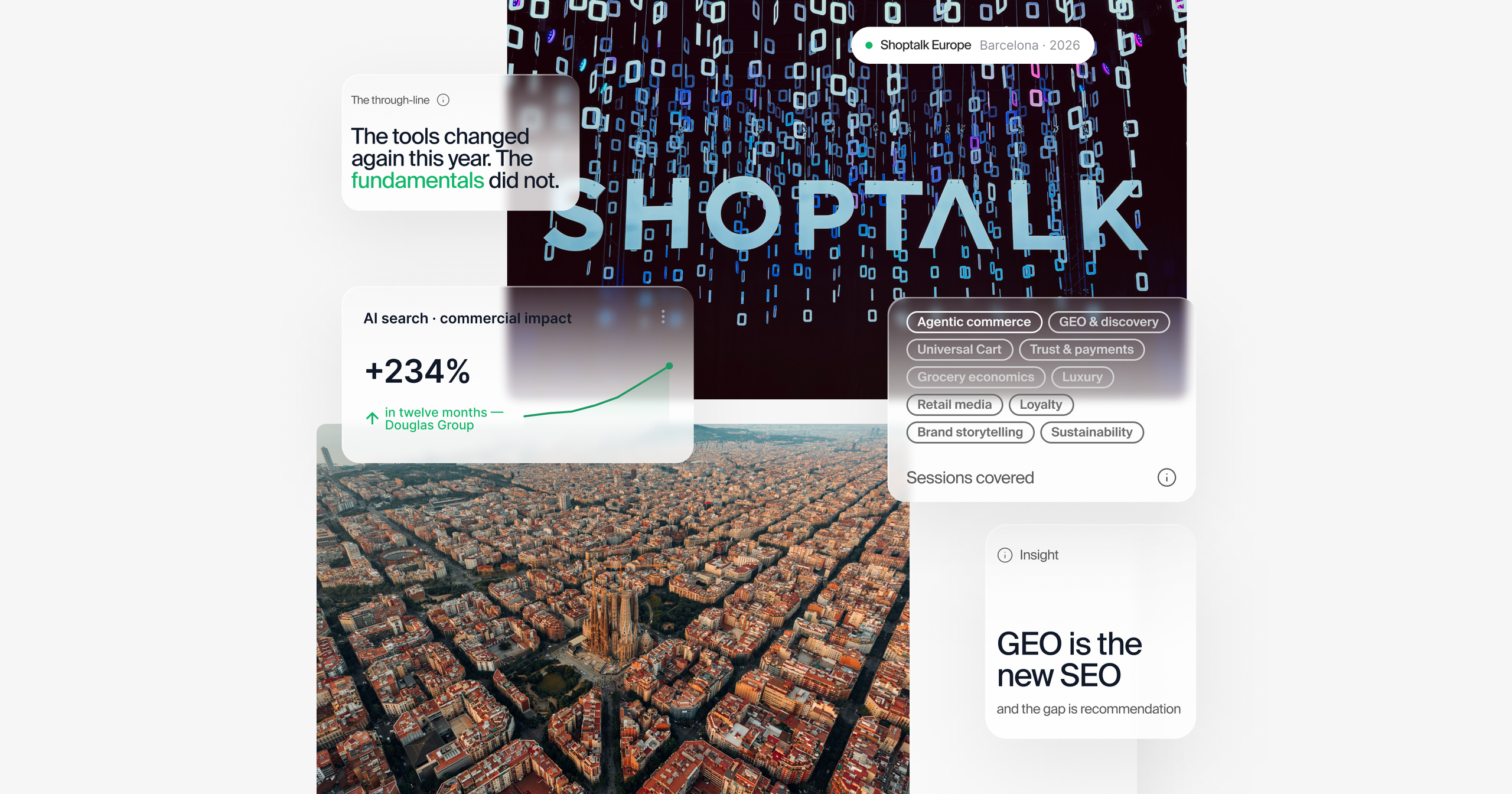
- GEO is the new SEO, and the gap is recommendation. Winning discovery in an LLM does not guarantee the sale. The new job is to be the product an agent actually selects, then convert that intent. Several speakers now treat this as a distinct function with a named owner.
- AI search is tiny but compounding. Across retailers it is still under 1% of traffic, but it converts higher and is growing fast. Douglas put the commercial impact of AI search up 234% in twelve months. The advice was the same everywhere: start now, even though the dashboard does not justify it yet.
- Trust is the real currency. Trust between consumer and agent, and between brand and platform. It came up in nearly every session, from Google's payment protocols to L'Oreal's view on neutral agents to The Ordinary's pricing transparency.
- Discipline beats noise. The brands that stood out, Louboutin, The Ordinary, Finisterre, Bremont, were not the loudest. They had a clear filter for what they would and would not do, and they held to it.
The sessions
A session by session look at the talks we sat in on, with the key takeaways and a quote worth keeping from each.
Agentic Commerce: What's Here, Real, and Next?
Dido Schmidt (Director of Global Partnerships, Commerce, Google) and Mark Elkins (General Manager, Global Ecommerce, L'Oreal)
Two halves of the same shift. Google laid out the plumbing being built for agent-led shopping, then L'Oreal explained what a brand actually has to do to win in it.
- Shoppers want to delegate the boring half. People still love discovery, but they are happy to hand a long checkout, an inventory check, or a store lookup to an agent. Google's framing is that AI takes friction out of the parts nobody enjoys, and leaves the joy of discovery intact.
- No trust, no adoption. Google is investing heavily in the identity and payment foundations of agentic commerce because the whole thing stalls without trust on both sides. Two open standards anchor that: the Universal Commerce Protocol, a common language so agents can interoperate, and the Agentic Payments Protocol, which builds in mandates and accountability so a transaction only goes through when its criteria are met.
- Universal Cart is the near-term feature to watch. An intelligent cart that lets a shopper save intent mid-journey and complete later. For merchants it recaptures purchases that otherwise die as a forgotten bookmark. Launching first in the US, with Target and Walmart named as interested.
- Data readiness is the homework you can do today. Enrich product feeds with conversational attributes so agents can surface your products with the right context. The open-source protocol is available now, even where Google's own services have not rolled out.
- "Shopping is coming to you." Mark Elkins's one-line summary of the shift. You used to go out and search and do the heavy lifting. Now shopping is an always-on activity that arrives through feeds and agents.
- Beauty is an early winner because it is hard. It sits near electronics and apparel as a top AI-shopping category, precisely because it is personal and overwhelming, the kind of decision that used to need a dermatologist or beauty advisor. Agents are taking on the non-medical parts of that advice.
- L'Oreal's three moves for brands. First, shopper research to learn which shopping missions and territories you can own. Second, content enrichment with intent-driven attributes (their example: "face cream for playing outdoor sports" needs far more data than old SEO ever required). Third, partnerships with both retailers and the LLMs. L'Oreal is now producing roughly five times the product data at ten times the speed.
- Old SEO still feeds new GEO. The two are interconnected, not sequential. Keywords and clean content remain fundamental.
- Watch the battle for context. China is further ahead, with super-apps like Qwen and Doubao where consumers happily authorise agent payments. The lesson for Western retailers: go upstream or risk being disintermediated by the LLM platforms capturing life context, not just shopping context.
- Do not expect a neutral agent. Elkins is sceptical that any general agent will be free of monetisation somewhere in the chain. Whoever genuinely solves that wins on trust, which is the real game.
- Agentic category management is the old job in new clothes. Assortment, bundles, routines, price points, the bread and butter of category management, applied to how an agent navigates your category. The new wrinkle is that Google, ChatGPT, and Claude are now partners alongside the retailers.
“Shopping is coming to you. You can call it the lazy person's shopping now, because shopping is now coming to you.”
Mark Elkins, L'Oreal
Getting Seen in the Age of AI Commerce
Rik Strubel (CMO, Douglas Group), Andrew Lederman (VP Global Digital Commerce, Mondelez International), and Amish Mehta (Director of AI & Agentic Commerce, Boots), hosted by Gemma Sims (WPP Marketplace Centre of Excellence)
Three back-to-back conversations, a retailer, a brand, and a retailer building the function from scratch, on how to stay visible as discovery moves into AI.
- Discovery has moved upstream. Douglas sees customers arriving already informed, digging deep into beauty before they ever reach a Douglas surface. The job has shifted from generating traffic to validation and fulfilment: the right product, price, and delivery for a decision largely already made.
- Small volume, big impact. AI search is under 1% of Douglas's traffic, but it converts higher (lifting their average from around 4% to over 5%), and its commercial impact grew 234% in twelve months. Move your focus from traffic to influence.
- Ratings and reviews became visibility, not just conversion. They are the trust signals LLMs are hungry for. Combined with a 61-million-member loyalty programme and authentic UGC, they are how a 160-year-old retailer keeps its authority in an AI world. Younger shoppers are more sceptical of AI, which is an opening for trusted human reference points.
- Market to the agent as well as the consumer. Mondelez built "agentic marketing" as an in-house capability. Brand marketers now also serve agents the format and facts (ingredients, nutrition) they need to digest.
- Win recommendation before conversion, and measure it. Mondelez runs GEO metrics across visibility, sentiment, and citation. One simple answer can pull from around 30 citation sources, and 35% of their LLM sources are earned media. They stack-rank by what matters against how hard it is to change (a brand-site edit is easy, large-scale earned media is not).
- Context and occasion are the content unlock. An endurance athlete, a Halloween shopper, and a parent packing an after-school snack are three different jobs for the same bar. Mondelez invests in long-form contextual text and video to hit each.
- Wherever discovery goes, the dollars follow. Lederman's bet is that consumers spend more time inside general LLMs like ChatGPT and Gemini, ordering both complex and very simple repeat purchases. That makes where discovery happens the single most important question for retail media.
- Kill the cognitive load. Mehta's case for GEO at Boots: nobody wants to search, click, then wade through filter bars. Customers already use several AI systems to find what they want, so Boots has to show up across that ecosystem for health, beauty, and wellness.
- Build for protocol-agnosticism. Off-site agentic commerce has not hit the UK yet, so Boots is building foundations that interoperate with whatever wins, Google's UCP, OpenAI's protocol, or in-app, rather than betting on one.
- Change comes from the workforce, not a mandate. Boots is empowering teams to test and explore, finding internal change agents, and turning store colleagues and commercial teams into a content engine that builds authority across the LLMs.
“People do not want this cognitive load. As consumers, they are already using a multitude of AI systems to find what they are looking for.”
Amish Mehta, Boots

Unlocking Ecommerce Profitability: Alcampo and Ocado on Delivering for Changing Consumer Needs
Carlos Pedreiera Freire (CEO, Alcampo) and Gregor Ulitzka (President Europe, Ocado)
A grounded look at the economics of online grocery, and a five-year partnership that turned Madrid into a proof point.
- Do not bolt online onto your store business. If you tack e-commerce on and leave everything else unchanged, you are almost destined to lose. Online grocery has to be rethought end to end, not added as a feature.
- It is an operations and automation game. Margins are thin and grocers hate complexity. The edge comes from supply chain, waste reduction, and last-mile optimisation. Alcampo's Madrid fulfilment centre runs more than 50% robotic picking, which shortens the chain and keeps food fresher.
- There is no single right model. Centralised fulfilment centres, dark stores, and store-pick are not a pendulum to swing between but a toolkit. Different markets and densities call for different mixes, and most operators use more than one at once.
- Operational excellence is the whole game. You can have the best range and the sharpest prices, but if you arrive late with missing items and meat that is not fresh, the customer does not come back. Online, execution is the brand.
- The Madrid numbers. Orders per day up around 60% year on year, NPS up 71%, and a perfect-order rate above 98% across a catalogue of more than 130,000 articles. Carlos called it growth he had not seen in his career.
- Partnership lessons. A shared vision (to lead physical e-commerce in Spain), real trust, and complementary strengths. Both sides admitted that five years in, the relationship looks nothing like the supplier deal they first signed. They now co-develop proposition, customer strategy, and supply chain together.
“You can have the greatest range and offer very sharp prices, and then you come late, one in two items is missing, your meat is not fresh. That customer is not coming back.”
Gregor Ulitzka, Ocado
Inside Christian Louboutin: Creativity, Innovation and the Making of Desirability
Alexis Mourot (CEO, Christian Louboutin), interviewed by Rebecca Bemhena (Shoptalk)
A mainstage keynote on running two innovation systems at once, and the discipline of deciding what a brand will not do.
- Run incremental and radical innovation in parallel. Mourot pointed to research on 19,000 pharmaceutical patents: highly cohesive teams are excellent at improving existing products and poor at creating new ones. The fix is to hold both, incremental innovation from inside the company, radical innovation from outside it.
- The outsider matters. His cautionary tale was Kodak, whose engineers proposed a digital camera in 1975 and were told it would never work. To bring in genuinely different thinking, Louboutin recently hired an external shoe designer whose new direction the internal teams are told to protect rather than smooth away.
- Evolve the core, do not revolutionise it. The Misty pump, a lower-heel take on their hero stiletto, launched only 18 months ago and became the number one product, rare for a 30-year-old house. It carried two innovations: a more comfortable structure, and an "everlasting" red sole that no longer wears off as you walk.
- Hero products sell desire before they sell units. Desirability comes first, conversion follows.
- Five brand pillars as a yes/no filter. Every project has to be joyful, audacious, Parisian, authentic and timeless, and tongue-in-cheek. If a collaboration misses any one of them, it does not happen. The spring-summer pool show, with Olympic synchronised swimmers wearing Louboutins underwater, was the framework working in public.
- Discipline over reach. Louboutin walks away from commercially attractive collaborations that do not fit, wary of the reach-versus-desirability trap that has caught other luxury houses.
- Retail is the marketing. With around 165 owned stores and only a couple of percent spent on communication, the brand is built on word of mouth and editorial. Store concepts are deliberately varied by city, so you will not find the same shoes everywhere, which gives customers a reason to visit and to come back.
“We prefer missing an opportunity to making a mistake.”
Alexis Mourot, Christian Louboutin

Brand Storytelling: Messaging that Moves
Elen Barnes (CMO & Digital Officer, Bremont Watch Company), Amy Bi (Global VP Brand, Deciem / The Ordinary), and Bronwen Foster-Butler (CMO, Finisterre), hosted by Brand Society
Three CMOs, three very different brands, on building advocacy through story rather than spend. Heritage luxury, rebellious beauty, and purpose-led outdoor.
- Sell the motivation, not the demographic. Bremont, the only luxury British watchmaker and a clear challenger, targets interests like adventure, exploration, and aviation rather than chasing a young audience. A watch purchase runs on an 18-month "romance cycle", so the job is keeping the narrative fresh long enough to convert.
- Give the story somewhere real to live. Bremont organises product into universes (land, sea, air, space) and hangs concrete stories on them: a watch heading to the moon on a NASA lunar rover, watches tested in Martin Baker ejection seats, a Felix the Cat collaboration with Universal that ran a full 360 activation down to a wrapped London taxi. Limited editions create the heat, but the core collection drives the business.
- Challenger status is a permission slip. Being small and independent means fewer rules, quicker decisions, and the freedom to tell new stories rather than lean only on heritage.
- The Ordinary throws out the marketing rule book. Born from a belief that skincare needed more pricing transparency, it treats marketing as a long-term brand asset that shows up in unusual ways. The clearest example: during the US egg-price spike, it rented fridges in New York and sold eggs at a fair price, a two-week campaign that reached around 100 million people and tied straight back to its belief in pricing fairness.
- Build agility into the plan. Deciem keeps 80% of the year planned and 20% open for reactive cultural moments. A simple internal test governs what ships: "if it's not a hell yes, it's a no", paired with "what are we willing to be cancelled for?"
- Listen to the community, but do not be led by it. The Ordinary mines a 100,000-strong Facebook group, Reddit, and DMs for product ideas (the VoluFeline serum came from exactly that), then balances it against 130 in-house scientists. Listen only to consumers and you can lose your way.
- There is a space for small. Success does not require a million people. Land ten deeply and that can matter more.
- Differentiate by where you stand, literally. Finisterre's point of difference is that most outdoor brands are "built from the mountains", and it is built for the coast. The founder was a cold-water surfer in Cornwall serving a community the warm-water industry ignored, with sustainability baked in from the first recycled-polyester fleece.
- Grow through a niche, not away from it. Finisterre stays distinctive enough that real surfers trust it (they "smell a kook a mile away") while a halo of aspiration pulls others in. When the brand once drifted into generic "accessible adventure", a new team pulled it back to its roots.
- Do activism through community, not at it. All of Finisterre's activism ladders to ocean access and water health. Rather than campaign directly, it backed Surfers Against Sewage to tour the UK ahead of local elections. The partner was the mouthpiece. The brand simply enabled it.
“Most outdoor brands are built from the mountains. We are built for the coast.”
Bronwen Foster-Butler, Finisterre

Until next time
If there was one through-line in Barcelona, it was the same one that has held for a while now. The brands and retailers pulling ahead are the disciplined ones. They are getting their data and content ready for an agent-led future, they know exactly who they are talking to, and they treat brand, operations, and story as one job. The tools changed again this year. The fundamentals did not.


