Pulse eCommerce Summit 2026: The Recap
This was Commerce-UI’s fifth Pulse eCommerce Summit. We’ve been there since the very first edition. This year our founders, Simon and Michael, went to London and sat in on the panels. With several stages running at once, we’d have loved to be at every session, but we had to pick. These are the ones we made it to.
What follows is a working recap of the sessions that stood out: the ideas worth keeping if you run a brand, manage eCommerce, or sit anywhere near growth, CX or operations. Each one has the key takeaways and a quote worth remembering.
Contents

The big themes from day one
From the closing “Recap of the Major Trends” session.
- Brand building is a serious commercial lever, not a soft one. The businesses that win the next phase will not just optimise channels better, they will build communities people genuinely want to belong to.
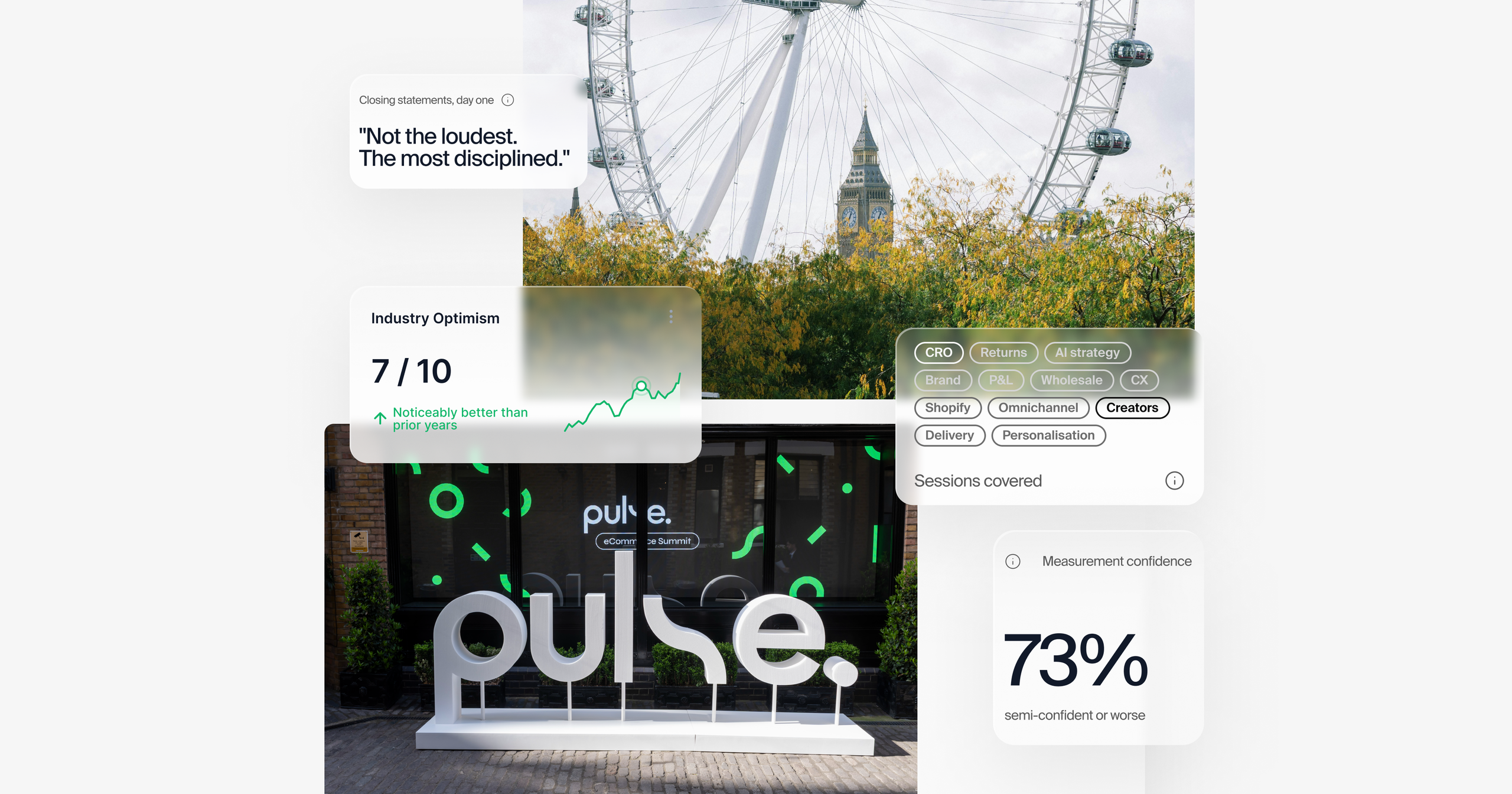
- Disciplined beats loud. The most successful brands this year were not the loudest, they were the most disciplined.
- Optimism is back. The Pulse survey put industry optimism at a healthy 7 out of 10, noticeably better than the past few years.
- Fundamentals over new channels. Performance marketing and CRM still dominate investment, with emerging channels like WhatsApp gaining traction. But the next wave of growth comes from executing the fundamentals better, not discovering entirely new channels.
- Measurement is the industry’s biggest unsolved problem. Not one survey respondent was “very confident” in their measurement framework, and around 73% were only semi-confident or worse. The 2026 challenge is translating data into insight and action, not gathering more of it.
- AI amplifies fundamentals, it doesn’t replace them. Strong brands, strategy, customer understanding and operational foundations still matter most.
“The brands most successful this year are not those which are the loudest, but those which are the most disciplined.” — Closing statements, day one

↑ Images courtesy of the Vervaunt team.
The sessions
A session-by-session look at the talks we sat in on, with the key takeaways and a quote worth keeping from each.
1. Cutting Through the Noise: What Meaningful CRO Actually Looks Like
Nick Phipps (Vervaunt)
A sharp argument that most site optimisation teaches you nothing, and a simple framework for making your decisions connect and compound over time. Works whether you run a formal CRO program or have never run a test.
- Reasonable changes can still teach you nothing. His example: moving delivery info above the fold. Sensible call, numbers stayed flat, filed as done. You changed the site but learned nothing about why customers hesitate. Do that for years and you get a site changed hundreds of times by smart people, with none of the knowledge written down.
- The brands that pull ahead aren’t the ones spending most on testing. They are the ones whose decisions are connected: a clear thread between what customers tell them and what gets actioned next. You do not need a big team, a budget, or fancy tools to start.
- Change the question. Instead of “what should we change here,” ask “what problem are we solving, and how will we know if we got it right?”
- Three traps that share one root. Copying competitors (you are copying their answer to a different question), celebrating a win then burying the report, and solution-led work (having an idea and rationalising it afterwards). The common root: the decision is not connected to anything upstream.
- Name the problem before the solution. Categorise problems by type: certainty, attention, motivation, friction, or choice. These categories are durable and taggable, so over time they accumulate into real intelligence rather than one-off results.
- A losing test stops being a dead end. When everything is tagged with objective, problem, solution and result, a failure tells you something specific: this type of solution did not fix that type of problem for this objective.
- Let the evidence redirect the roadmap. If certainty tests win one in three but friction tests produce nothing across five attempts, friction probably is not your issue right now. If copy changes beat redesigns on certainty, your certainty problem is a messaging problem, not a layout one.
- Know when to ship, test, or personalise. Ship when research makes you certain. A/B test only when you have genuine uncertainty and enough traffic to hit significance in a reasonable window, otherwise it is theatre. Personalise when research shows no single universal answer exists.
- Be comfortable with failure. Roughly one in ten changes pushed live actually move the objective. The point is not to avoid failure, it is to learn from it and document it.
“Copying the answer without understanding the question is just guessing.” — Nick Phipps, Vervaunt
2. What Does Returns Excellence Look Like in 2026 for Boden and Selfridges?
Amy Allen (Selfridges), Colin Dawes (Boden), and Kristie Cannings (ZigZag), with research presented by Richard Lim (Retail Economics)
Retail Economics and ZigZag presented joint research on returns, then a panel from Selfridges and Boden dug into cost, speed, and what actually drives loyalty.
- The industry is wildly inconsistent on returns, and that’s the opportunity. The research team ordered and returned 100 products from the 100 largest clothing and footwear retailers. Only 24 offered truly free returns, one in ten still made you print a label, and one retailer’s returns process failed four times before they gave up.
- Treat returns options like checkout options. Selfridges puts as much effort into returns flexibility as front-end checkout, because both drive conversion and loyalty. Match the option to the customer and the product: a single lipstick and a Louis Vuitton handbag should not get the same returns journey.
- Ease wins, cost is close behind. The research ranked ease (simple, accessible, minimal effort) as the top pillar of returns excellence, with cost next at 74% of consumers. People are still sensitive to fees.
- Charging for returns is now normal, and the data says it’s safe within limits. ZigZag’s view: the old fear has faded, and retailers that switched on a fee are not seeing conversion drop. The sweet spot is roughly £2.49 to £2.99, a little more for home collection, but push past that and you create friction.
- But the fees stack up and damage sentiment. Amy’s own story: a £600 purchase from another retailer, £12.99 to get it next day, £6.99 to return it, plus an admin fee. It did not fit, and she felt continually out of pocket. The cumulative cost is what sours the relationship.
- Speed of refund is a real differentiator, and it varies enormously. The audit found refunds ranging from two days to over a month. Selfridges is engineering the whole chain: acknowledge the return the day it lands, process the stock within 12 hours, and get it back to a prime resale location fast.
- The next frontier is refunding before the product is back. Selfridges wants top loyalty members refunded on the first carrier scan, so they can shop again while the parcel is still in transit. The counterweight, from ZigZag, is fraud: segment by return-versus-keep behaviour and risk-score so you do not refund early. Boden takes the opposite stance, keeping it simple with free returns across all markets and no segmentation.
- AI is coming for the grading bottleneck. Human grading is expensive and scarce (Selfridges currently brings 100% of returns back to the UK to be graded). Emerging options: local in-country grading, photo grading, customers grading at home by scan or photo, WhatsApp returns, and agentic chatbots.
“It’s already an unhappy path journey. The customer’s already converted, they’ve bought something they love. Our ambition is that they don’t have to go searching for how to return it.” — Amy Allen, Selfridges
3. AI Strategy & Transformation with COS
Simone Williams (COS), interviewed by Paul (Vervaunt)
A grounded, hype-free look at how a global fashion brand with around 250 stores is actually adopting AI: where they started, how they govern it, and a refreshingly skeptical take on the pace of change.
- Make AI a named strategic shift, not a side experiment. COS folded AI into its 2030 strategy, which gave it structure, governance, and both top-down backing and bottom-up buy-in. They spent roughly six months talking to the business to map opportunities and friction points before acting.
- Three pillars, sequenced by effort and impact. Productivity (human-centric, AI supports colleagues), customer experience and digital marketing (the low-hanging fruit: translations, copy, asset production), and integrated supply planning (hardest and slowest, but the biggest payoff across stock-to-sales, profitability and sustainability). Start where impact comes fast to build confidence.
- Don’t build an “AI team,” make AI everyone’s job. COS deliberately chose to upskill existing people across the entire head office rather than create a siloed AI function. AI champions, L&D programs, and faster tracks for those who want to be pioneers.
- Security and compliance come first. Their number one priority is teaching employees how sensitive information can be exposed outside closed-loop systems. Governance is light but real: a steering committee every two weeks, mapped to the three pillars so projects do not scale out of control.
- Translations were the easy, high-value first win. They were translating too slowly across many markets, spending heavily on external agencies, and delaying launches. Internal models plus leveled-up language managers let them launch products and enter new markets far faster.
- Workflow management was a quiet transformer. Teams were burning huge amounts of time chasing assets across email, Teams and WhatsApp. A workflow tool with AI adoption changed the pace of operations.
- Optimise for discoverability now, even though the data doesn’t show it yet. Customers are starting brand and product discovery in LLMs, but it is still under 1% of measurable traffic. COS is acting on what they hear from customers, not just the dashboard, and building for flexibility because the ground keeps moving.
- The real challenge comes after the rollout. COS just finished a three-year digital transformation. The hard part now is shifting from running a program (a fixed end state) to running a digital product team (continual evolution): clear ownership, board alignment, and constant repetition of the “why.”
“I don’t believe that websites are going to be dead by 2028. Customer behaviour is going to change, we can already see that. But this is just another phase of digital.” — Simone Williams, COS
4. An Interview with Dame Anya Hindmarch
Anya Hindmarch (founder), interviewed by Ed Bull (LimeSharp)
A wide-ranging conversation on building a brand with conviction, why physical retail still matters, and turning sustainability into a product people actually want.
- Creativity is a discipline, not a thing you wait for. Hindmarch feeds her brain on purpose: exhibitions, reading, travel, conversation. Then she banks ideas in an organised way and comes back to them later. The good ones resurface.
- Every creative project hits “the dip.” It starts exciting, gets complicated, gets expensive, and you start to hate it. She says most good ideas die there. Knowing the dip is coming is what lets you push through it.
- Don’t start from what’s commercial. Start from what genuinely excites you. Chasing commercial up front dilutes the idea. Creative and commercial are not opposites; odd, different ideas are often the ones that end up selling.
- Physical retail needs a reason to visit. Her Chelsea Village is the deliberate opposite of the 65 cookie-cutter stores she once ran: localised, project-driven, real (a cafe, a fruit and veg shop, a Santa’s grotto). It is a counterbalance to digital, not a copy of it.
- Connect people to problems visually. For the plastic bag work she filled her store windows with around 90,000 used bottles to show what “nine seconds of landfill” looks like. The “I’m not a plastic bag” project pushed an actual legislation change. Make the problem something people can see.
- Build sustainability into the product, not the marketing. The Universal Bag fixes the failed “bag for life”: guaranteed to last ten years, recycled locally, foldable so you can post it back through any letterbox to be recycled. Rolled out across roughly 20 countries.
- Starting a brand is easier in some ways now. D2C means you are not at the mercy of department stores and magazines. You can speak directly to your tribe. And “it’s okay not to be cool,” you just have to be honest with your community.
“If retail is to exist in a digital world, there needs to be a reason to visit.” — Anya Hindmarch

5. Economics of Scale: Capital, Commerce & the P&L
Steve Hewitt (ex-Gymshark CEO, now founder of Whanau Advisory and an investor), interviewed by Paul Rogers (Vervaunt)
A commercial deep-dive on what makes a business worth backing, when to raise, and how to manage investors and teams when things go wrong. Drawn from building Gymshark from £5M to £500M and now investing in brands like Passenger and AU Vodka.
- Start with people, not the P&L. Most investors go straight to customer economics. Steve starts at the other end, with the four-bucket “North Star” that took Gymshark from £5M to £500M: why you exist (purpose), who you exist for (audience), your value set and environment, and the business model. Lose focus on purpose and audience and you drift into being opportunistic.
- The maths still have to work, and it starts with product margin. For anyone selling physical inventory, the first margin has to be strong. If product margin is weak, you sweat every line of the P&L for the life of the business, and it is brutal when input costs are rising. Get gross margin right and EBITDA follows.
- Don’t build your business for a financial event. Gymshark never built toward the 2020 raise. As co-founder Ben Francis put it, it was built “to outlast generations.” Look after the brand for the medium-to-long term and the maths look after themselves. The payday itself is underwhelming when it comes. Money buys one thing: choice.
- Time the raise in the middle of the curve, not the top. Go too early and you get seller’s remorse. Wait greedily for peak valuation and you leave nothing in the tank for the investor. Aim for roughly halfway up.
- Take the right investor, not the biggest cheque. Choose for value and culture fit, because you need alignment when things go wrong, and plan A never comes off. General Atlantic fit Gymshark because they were strong exactly where Gymshark was weak: the US and physical retail. An investor, like a non-exec director, has to keep adding value, not just write a cheque.
- Don’t lie, and don’t over-trade into a deal. Some brands over-trade for 12 months before a process, discounting and cutting costs to look lean, and quietly kill the brand. The investor buys in, finds no substance, and holds you to the plan. Be a little soft on your numbers and manage expectations instead.
- Give good news early and bad news earlier. After the General Atlantic deal, Steve ignored advice to limit investors to quarterly board meetings and instead sent weekly trading digests. By board time, expectations were already set on what was working, what was not, and what they were doing about it. Lie about the numbers and you get found out fast.
- Win investment through brand, not just performance spend. Do not overload Google and Meta. The brands that do best in funding rounds can tell a story and build viral moments, which is exactly what Gymshark excelled at.
- Back people for values, and reject ego. Work ethic, grit and kindness “take zero talent.” Ego is a non-negotiable walk-away, captured in the blunt Gymshark hiring line that they would rather have “a hole than an arsehole” in the business.
“Do not build your brand or your business for that financial event. You will only get it wrong.” — Steve Hewitt
6. Building Your Creator Strategy from Two Globally-Recognised Creators
Oren John (@orenmeetsworld) and Clayton Chambers
Two full-time creators, both ex-brand and ex-eCommerce, broke down how brands should actually build and scale creator programs. Very tactical, light on theory.
- There’s a new layer between owned and paid media, and it’s where the advantage is. Oren calls it the “enabled” layer: founders, employees, hired creators, seeded creators and affiliates all making content about you. Owned plus enabled is what grows the organic conversation around a brand and compounds. Most brands still have not made the shift.
- You can’t buy your way in anymore, you earn it. Consumers see through paid posts. Your product and brand message have to be interesting enough that creators want to talk about you on their own.
- Good content sits where entertaining meets valuable. For most brands the highest-value move is simple: put an expert on camera talking about the problems your customers actually have. Your product does not need to be the centre of the video.
- Treat creators like signed athletes, not one-off posts. Multi-month or multi-year partnerships build trust and let the creator’s audience actually learn who you are. A single post does nothing because the audience has no context for your brand yet.
- Kill the strict scripts. Build around what the creator already does well and let them say it in their voice. Forced, scripted reads damage the content and the relationship.
- Scaling works because of how algorithms stack interest, format and person. To reach more people you need many creators across formats and demographics, not one big influencer. Brands winning here run hundreds or thousands of creators, often on affiliate percentage deals tied to a CAC-to-LTV target.
- Feed winning organic creator content into your paid accounts. Take the assets that perform organically and test them as ads on Meta, YouTube and TikTok. Do this and you stop running out of ad creative.
- Your first creators are already your customers. Scan your email list for customers who have a social following and start there. They already know the product, so it is the easiest zero-to-one win.
“The best thing 90% of brands can do with a creator is get an expert on camera talking about the things those people are dealing with.” — Oren John

7. Beyond DTC: Making Retail and Wholesale Actually Work
Lawrence Montgomery (Rough Trade), Tom Clements (Mint Velvet), Chris Perrins (Gymshark), moderated by Luke Hodgson (Commerce Thinking)
Three brands that expanded beyond DTC into retail and wholesale shared the unglamorous lessons: integration pain, forecasting for a calendar you don’t control, and why “full omnichannel” is usually the wrong goal.
- A new channel is never “just Shopify again.” Clicking “add app” is easy. The complexity is all downstream: data, finance, ops, reconciliation. Every channel has genuinely different requirements, and you cannot copy-paste the lessons from one to the next.
- Don’t bundle problems, sequence them. Rough Trade ran a huge Shopify migration (around 600,000 SKUs, three catalogs merged into one global catalog) alongside other big changes at once. Separate the problems and tackle them one at a time, because each solved problem makes the next easier.
- Don’t outgrow your infrastructure. Rough Trade’s worst moment traced back to scaling into channels before the back office could support it. Patience would have been cheaper than the cleanup.
- Build a buffer around big migrations, and QA hard. Problems do not all show on launch day. They aggregate and surface a week or ten days later. One panelist booked a trip the week after go-live and the real issues hit while they were away.
- Get Ops, Finance and Merch in the room before launch, not after. Those are the teams left covered in the mess when something goes live looking fine but is not. Pull your worst surprises as early in the process as possible by having the painful conversations up front.
- Wholesale runs on a calendar you don’t control. With your own drops you set the dates. With a wholesaler you are filling stock they have already planned revenue around. A missed production or freight date is easy to hide online and impossible to hide with a retail partner.
- Keep store operations simple. Gymshark set up its flagship like a mini-DC, with a bin location for every one of around 30,000 units. Six months later, with high retail staff turnover, stock was everywhere. Do not put a mini-DC in the store: fewer scans, simpler process, accurate stock.
- “Full omnichannel” is shooting for the moon. Pick the flavour that fits. Rough Trade: click-and-collect works, ship-from-store does not (records make heavy, awkward baskets). Mint Velvet: ship the full range from the warehouse because stores carry a limited range, but do not ship from store.
- Click-and-collect only counts if the pickup is good. Offering it means nothing if the customer waits five minutes at the counter while someone hunts in the back. A bad collection experience loses the customer no matter how many options you advertised.
“Maybe it has to be an acceptance that full omnichannel, you’re shooting for the moon. You need to choose what flavour of that is right for your business.” — Lawrence Montgomery, Rough Trade
8. Unlock Growth with AI Powered A/B Testing & Personalisation
Harry Roth (Laura Geller) with Mark Adelman (Visually)
A CRO masterclass wrapped in a tool demo. The useful part is Harry’s hypothesis-led philosophy and a set of concrete test stories from Laura Geller, a beauty brand with a heavy testing culture.
- No test is a losing test, if you start with a hypothesis. Even when a test loses, you learn something about your customer. The goal was never just a winner. It is understanding why something worked, who it worked for, and where it did not.
- Always start with the why. Testing “should the button go here or there” teaches you almost nothing. A real hypothesis lets you explain the result to the rest of the business, and that learning compounds.
- A losing test that turned into $1.2M. Laura Geller ran a free-shipping progress meter that lost for the first time ever. Instead of binning it, they realised showing it early in the journey hurt. So they raised the free-shipping threshold from $40 to $50 instead. Zero impact on conversion, and around $1.2M in additional revenue.
- Fix the funnel where it actually breaks, not where you assume. Their discovery kit hit 3x the normal add-to-cart rate but lost people before checkout. Customers did not understand what they would actually receive. They reskinned the cart experience just for that product and saw a big lift.
- Velocity beats big swings. Most brands run two or three tests a month at roughly a 30% win rate, so the impact is tiny. CRO is a game of increments and compounding small wins, not occasional home runs.
- Don’t wait for pixel-perfect. If every test has to be 100% perfect before launch, you will never hit velocity. 95% there with a confident read is enough to start learning. The hardest part is just starting.
- Take your own taste out of it. “It’s not about you.” When someone brings a test idea, your job is not to say “I don’t like that.” It matters what the customer thinks. And sharing winning hypotheses across departments lifts the whole business.
- Small, customer-specific wins move the needle. UK customers were sensitive to free shipping, so they flagged it on product pages for items above the threshold. 4% conversion lift within days. You will not find that in a UX audit.
“If you are doing CRO the right way, using your data and creating a hypothesis, no test is a losing test.” — Harry Roth, Laura Geller
9. Fit for Purpose: Naked Copenhagen’s Revenue-Led CX Strategy
Simon (Naked Copenhagen) and Martijn (Ask Phill), with Neil (Gorgias)
A rare session focused squarely on customer experience: how a sneaker retailer turned a support crisis into a leaner, faster, revenue-generating CX function.
- Don’t “just buy the AI tool.” Fix the root cause first. Facing a ticket crisis, with a permanent backlog of 100-plus unanswered tickets, Naked Copenhagen resisted the CEO’s instinct to simply install an AI agent. They spent the first three to four months identifying what was actually driving customers into the inbox and solving those issues at the source.
- The results were dramatic. Tickets went from a constant 100-plus backlog to clearing to zero daily. The team shrank around 50% over six months through natural attrition, not layoffs, and the two remaining people now have spare capacity for eCommerce work.
- Treat customer service as a revenue driver, not a cost. Most brands run CX as a cost centre. Flip it. Every interaction is a chance to upsell, cross-sell, or drive retention.
- Get the foundation right before AI. A buggy platform generates tickets. Moving off a painful custom stack onto Shopify removed a big chunk of contacts before AI even entered the picture. Putting AI on a broken foundation just automates the symptoms.
- Speed beats perfection in CX. Naked’s AI agent scores higher on satisfaction than the human team, largely because it is fast. Even an imperfect answer earns positive feedback when it arrives unexpectedly quickly. The caveat: the AI hands complex tickets to humans, so it is not a like-for-like comparison.
- Redeploy freed-up time to revenue work. Once tickets dropped, Naked moved CX people onto newsletters and eCommerce tasks that drive business, rather than measuring the team purely on ticket volume.
- Pick a partner who knows your category, not just the platform. Naked researched the entire Danish Shopify agency market and found plenty who knew Shopify but not fashion. As a top-tier sneaker retailer, category understanding was the deciding factor.
“Most brands treat customer service as a cost. Turn it around and see how you can use it as a revenue driver. Every interaction is an opportunity.” — Martijn, Ask Phill

10. Future Ready Retail: Boden’s Enterprise Transformation with Shopify
Alexander Ives (Boden) with Deann Evans (Shopify)
A 35-year-old heritage fashion brand (women’s and children’s wear; main markets Germany, the US and the UK) on why it left a self-built composable stack for Shopify, and what that unlocked. Genuinely useful for anyone weighing custom versus platform.
- Heritage doesn’t mean digital novice. Boden has catalog roots (orders on paper, paid by cheque) but moved to eCommerce early and built its own engine before platforms like Shopify existed. Replatforming was still an early call for a brand its size.
- Composable-plus-legacy is expensive to run and to change. Launching a brand moment (a capsule, a sale) meant coordinating pricing, product, promotions and content across systems with no single owner, and every new feature carried a heavy engineering cost.
- Stop building commodity functionality. Most requests were new payment types and checkout features, the most legacy part of their stack. They asked the right question: why build PayPal and Klarna ourselves when every brand needs them? That drove the move to platform.
- Win finance and creative separately. Finance got a business case: a 10% cut in run cost, plus savings on change effort and a retired legacy platform. Creative got proof: a throwaway Shopify site mimicking their current one, to show it could meet their creative standard.
- Don’t turn the proof-of-concept into production. The demo had no product data and no payment or tax integrations. Building a demo is not the same as building with the full complexity of the business, and pretending otherwise sets you up to fail.
- Standardise the commodity, stay distinct where it counts. Checkout looks like any Shopify brand, and that is fine, familiar converts better. Shopify’s API richness let them go standard on most operations while staying disruptive in the experiences unique to Boden. Payments and taxes just work; they kept features like pre-order.
- Speed: 8 months became 12 weeks. Replacing their marketing platform took 8 months on the self-built stack. On Shopify the new platform (Ometria) went live in 12 weeks, because that integration path has been walked hundreds of times. They customise only what is special about Boden.
- Treat the platform like an ERP, not a front-end. They used to swap the front-end every ~3 years. Now Shopify is the centre of their architecture: make one big bet, then build everything around it. A key new vendor question is “how well does this play with Shopify?”
- Opening a US store became “press a few buttons.” Past UK retail meant heavy POS integration, promotion consistency across channels, and brutal US tax setup (rates can vary by street). Already on Shopify, their first US store was one of the easiest projects of his career.
- On AI, stay focused on what’s actually unique to you. Boden had a best-in-class AI search tool, but with only ~100 dresses and 20% of products driving over half of demand, the brand team just wanted to place ~20 products by hand. The tool was a sign they had lost focus. Being on Shopify lets Shopify own the agentic-commerce build, so Boden can switch it on when ready rather than wrangling its own MCP servers.
“You make one big bet, and then once you’ve made that bet, you try and stick everything around it. We’re looking at Shopify the same way now.” — Alexander Ives, Boden
11. Omnichannel at Scale: How French Connection and Ellis Brigham Are Winning with Personalisation
Ellie Lansley (French Connection) and Mark Oldham (Ellis Brigham), moderated by James Gurd (Digital Juggler)
Two multi-brand retailers on blending retail and eCommerce, mining store knowledge for digital, and resisting the urge to call automation “personalisation.”
- Customers don’t think in channels, businesses do. Blending retail and eCommerce is a mental reframe away from legacy systems and silos. Ellie’s fix: get retail, marketing, customer service and eCommerce in the same room, and send head-office staff on store visits so digital work actually benefits store teams.
- Mine your store staff’s knowledge and pipe it into digital. Ellis Brigham pushes staff expertise into product pages, fit guides and how-to content. In store, staff narrow a huge range down to two or three choices so customers are not paralysed. The goal is replicating that guided experience online.
- Don’t bury your full range in submenus. In store, customers see and browse everything. Online, showcase the activity worlds and let people drill in, without excluding anyone or second-guessing what they want.
- Get the data foundation before the personalisation strategy. Ellis Brigham replatformed and added Voyado about 14 to 15 months ago and is deliberately not rushing. They want to understand how customers actually shop now, after years of running on opinion. No strategy without data behind it.
- Your assumptions about customers are probably wrong. Ellie ran AB tests certain she knew the answer, was wrong, and started over. French Connection’s customers shifted from category-focused to situational and occasion-led within a year. Automation’s real value is getting that signal back fast.
- Try-before-you-buy, online and in store. French Connection lets customers order online and try at home with no commitment. They extended it in store: if something is out of stock, staff order it to the customer’s home, so they keep the store experience at home.
- ERP and stock are the unglamorous backbone. French Connection’s ERP migration was the biggest blocker, with a couple of months of stock disruption, but it is the prerequisite for fulfil-from-store, wider purchasing options, and expanded returns.
- Keep distinct brands distinct. Ellis Brigham deliberately runs Ellis Brigham, Snowboard Asylum and Outside as separate brands with separate teams, because basket data showed ski and snowboard buyers barely overlap. Consolidating into clones to chase a market “feels really shallow.”
- Watch the personalisation-versus-automation trap. The more tech you add, the easier it is for personalisation to slide into scripted, generic automation. Ellie’s anchor: at one talk full of AI tools, nobody mentioned the customer.
“We’re experts in products in store. But as soon as you go into the digital space, you need to be experts in delivery and experts in fulfilment.” — Mark Oldham, Ellis Brigham
12. Preparing for Agentic Commerce: Ellis Brigham’s Delivery Intelligence Journey
Mark Oldham (Ellis Brigham) with Piotr Zaleski (Ingrid)
A practical look at how a heritage outdoor retailer fixed its delivery and post-purchase experience, and a refreshingly skeptical take on what “agentic commerce” actually means for operations.
- Delivery is the unfinished part of the sale, and most brands fumble the end. Ellis Brigham got the experience right up to checkout, then fell apart: no order communication, confusing delivery promises, and in-store a cashier shoving an £800 jacket into a bag after a two-hour fitting.
- WISMO is a tax on your support team. When delivery status is not surfaced on the front end, customers flood you with “where is my order.” That buries customer service in reactive work and leaves no time to fix the deliveries that actually went wrong.
- Surface your operational reality to the customer. They ran a universal stock holding across warehouse and stores but never showed it. So a customer could pay for express and wait seven days, or pay economy and get it next day. The fix was honest delivery promises based on where the stock actually sits.
- Replatform by peeling the onion, not bending old systems. If a layer does not work, rip it out and replace it. They moved Magento to Centra, then added Ingrid for delivery and Voyado for search and merchandising.
- The payoff is measurable. At peak trading in 2025, WISMO contacts dropped 14% while orders rose 24% across their sites. Foundational delivery work compounds.
- Be pragmatic about agentic commerce. Mark’s filter for any buzzword: what problem does it solve, and how do we adopt it sensibly? The prerequisite is clean, correct product and service data so an agent can serve accurate answers. And watch the customer-data and privacy question.
- Stop racing to free and fast. You cannot go cheaper than free or faster than instant, and the cost to serve will sink you. The smarter move is intelligent delivery matched to the customer (not home on Thursdays, wants a greener option) and matched against lifetime value, not just the cheapest carrier.
“I’m always a bit like, what problem are you trying to solve? How is it going to solve it? How are we going to adopt it in a way that actually makes sense?” — Mark Oldham, Ellis Brigham
Until New York
If there was one thread across the two days, it was this: the brands pulling ahead are the disciplined ones. They fix the fundamentals, they know their customer, and they treat brand, data and operations as one job rather than three. The tools keep changing. The basics do not.
This was our fifth Pulse, and one of the best yet. Next stop is Pulse in New York, and we cannot wait. If you are heading over, come find us.

↑ We welcomed "Britney Spears". It wasn't the real one if you're not sure.


