BigCommerce vs Shopify in 2026: What the New Transaction Fees Mean (and When It’s Worth Switching)
Contents

Introduction
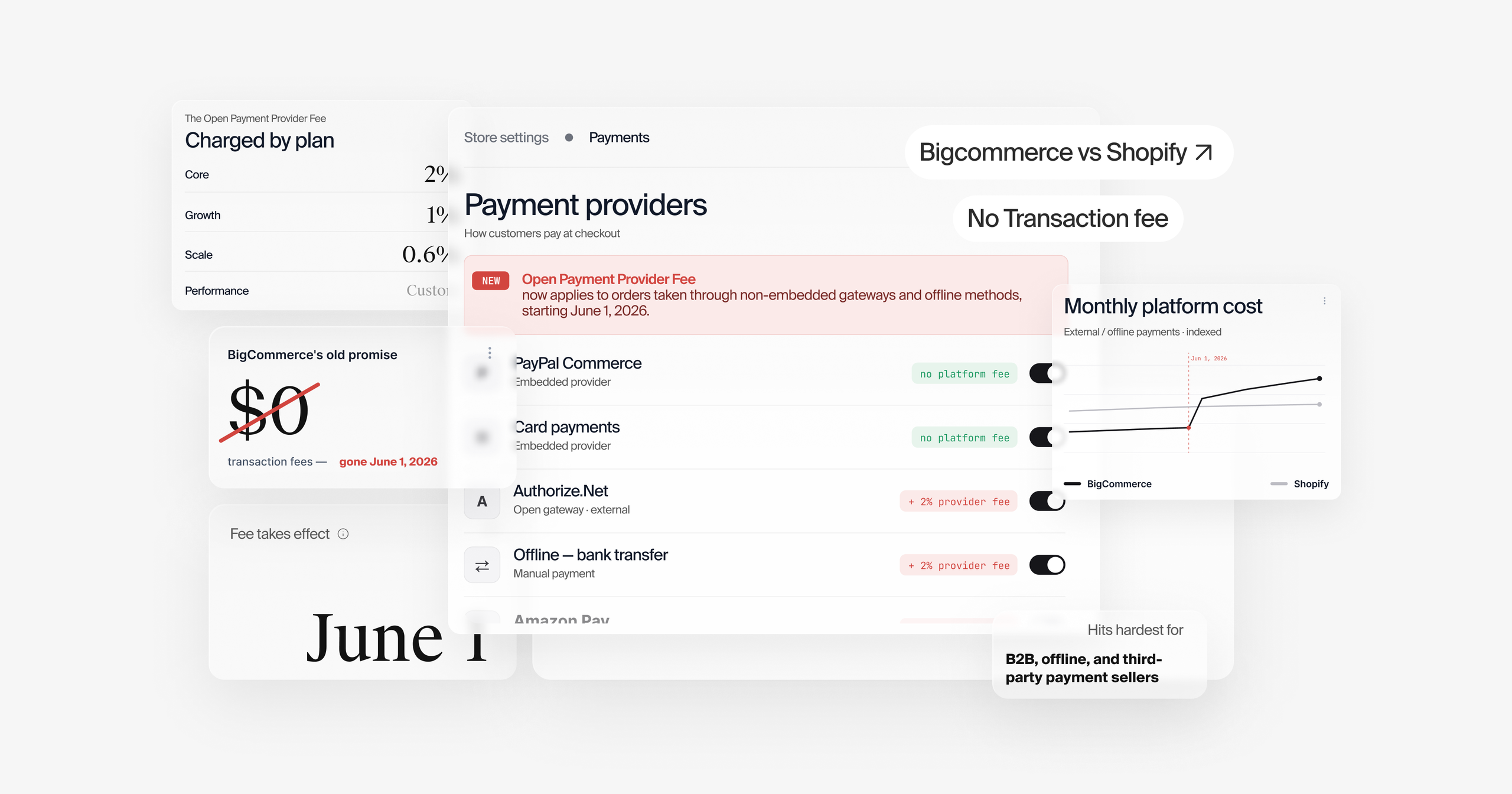
On June 1, 2026, BigCommerce started charging a fee it never used to. It's called the Open Payment Provider Fee. For years BigCommerce sold itself on one promise: no transaction fees, unlike Shopify. That promise is now gone.
We build on Shopify Plus and we move brands off other platforms, so read this as our take, not a neutral scorecard. We'll be straight with you about where it leans. Here's the honest version. The fee won't sink most stores. What it signals matters more. And for some merchants, mostly B2B sellers and anyone running offline or third-party payments, it really does change the math.
This is a breakdown of what changed, who it actually affects, how the real costs compare, and how to think about a move if you decide to make one.
What actually changed on June 1, 2026
BigCommerce did three things at once.
First, it added the Open Payment Provider Fee. If you process an order through a payment gateway that isn't on BigCommerce's approved "embedded" list, you now pay a percentage of that order to BigCommerce on top of your normal card processing. The rate depends on your plan:
- 2% on Core
- 1% on Growth
- 0.6% on Scale
- Custom on Performance
The embedded providers that escape the fee are a short list: Stripe, PayPal and Braintree, Adyen, and Checkout.com. Use one of those for your card payments and the fee doesn't touch those transactions. Use anything else and it does.
There's a catch most coverage missed. The fee also applies to offline and manual orders, including B2B purchase orders. So a wholesale customer paying on terms can trigger the fee even though no third-party card gateway was involved.
Second, BigCommerce renamed every plan. Standard is now Core. Plus is now Growth. Pro is now Scale. Enterprise is now Performance.
Third, it lowered the GMV thresholds that push you onto a higher plan. Core dropped from $50,000 to $30,000. Growth dropped from $180,000 to $100,000. In plain terms, you hit the next price tier sooner than you used to.
One more thing worth noting. BigCommerce published all of this quietly around April 1, on a page that wasn't linked from its main navigation, blog, pricing page, or resource center. Make of that what you will.
Who this actually hits, and who it doesn't
This is where most hot takes get it wrong. The fee is real, but it isn't universal. Be honest with yourself about which group you're in.
You get hit hard if you use a niche or local payment gateway that isn't on the embedded list. You get hit if a meaningful share of your orders are offline or manual. And you get hit if you sell B2B and process purchase orders, because those count too. If that's you, model the new fee before you do anything else. On a Growth plan, 1% of every affected order adds up fast.
You barely feel it if you run card payments through Stripe, PayPal, or Adyen. Those are embedded, so your everyday card sales don't carry the new fee at all.
So the cost hit is narrower than the headlines suggest. But here's the part that matters even if the fee never touches you. BigCommerce just gave up the one line it used to win deals against Shopify. "No transaction fees" was the pitch. Pair that with lower GMV thresholds that move you up the price ladder earlier, and the platform looks more expensive and less differentiated than it did a month ago.
A bit of context on where BigCommerce sits. It powers somewhere around 40,000 live stores today. BigCommerce cites 130,000-plus merchants, but that's a cumulative figure across 150 countries, not active stores. Either way it's small next to Shopify, which runs roughly 4.8 million stores worldwide and holds close to 30% of the US market. And BigCommerce was already shrinking before this change, with live store counts down about 8% year over year in early 2026. A platform losing share that removes its main selling point is worth paying attention to.
The honest cost comparison
Let's compare like for like, including the fees Shopify charges too. Anyone who tells you Shopify is fee-free is also selling you something.
| Factor | BigCommerce (after June 1) | Shopify |
|---|---|---|
| Plan names | Core / Growth / Scale / Performance | Basic / Shopify / Advanced / Plus |
| Fee on native card payments | 0% with an embedded provider | 0% with Shopify Payments |
| Fee on third-party, offline, or B2B PO orders | 2% / 1% / 0.6% by plan | Roughly 2% / 1% / 0.5% by plan if you don’t use Shopify Payments |
| GMV thresholds | Lowered (Core $30k, Growth $100k) | No GMV cap, you choose a tier by features |
| Where the cost bites | Non-embedded gateways, offline, wholesale | Using an outside gateway instead of Shopify Payments |
The honest takeaway is that both platforms reward you for using their preferred payment setup and charge you for going around it. The difference is the direction each one is moving. Shopify's structure has been stable. BigCommerce just made its more expensive and added a charge to order types, like B2B purchase orders, that used to be clean.
One thing most write-ups skip: enterprise customers on Performance contracts are typically exempt from this fee. It gets negotiated out as part of the deal. So the brands actually paying it sit on Core, Growth, or Scale, which is the smaller end of BigCommerce's customer base. The biggest merchants get a pass. The mid-market pays.
Whether the fee touches your specific brand or not, that's worth knowing. It tells you which way the platform is leaning.
It was never just about price
Cost is the reason people start looking. It's rarely the reason they switch. The bigger question is which platform lets you build what you actually want. Three things separate Shopify here, and two of them got wider this year.
The app ecosystem is in a different league. Shopify's app store has more than 17,000 apps. BigCommerce has around 1,000. That gap shows up in real work. When you need a subscription tool, a reviews widget, a loyalty program, or a niche integration, on Shopify it usually already exists and it's well supported. On BigCommerce you more often build it yourself or settle for a weaker option. More apps also means more competition, which keeps quality up and prices honest.
Checkout works differently on each, so be precise about it. BigCommerce gives you open access to its checkout on every plan. You can rework it with the Checkout SDK, add steps and fields, and build custom logic. In raw terms that's more freedom. The catch is it's a heavier engineering lift and you own the maintenance forever. Shopify takes the other route. Deep checkout customization lives on Shopify Plus through Checkout Extensibility, where you add branded content, custom fields, and logic through approved extensions that run in a sandbox. You get less raw access, but the changes don't break your PCI compliance and they survive Shopify's updates instead of breaking on them. For most brands, upgrade-safe and maintainable beats unlimited but fragile.
B2B, and this one flipped this year. Until recently, native B2B on Shopify meant Shopify Plus. In April 2026 Shopify opened its core B2B features to every paid plan: company profiles, custom catalogs with their own pricing, volume discounts, payment terms, and vaulted cards. So a growing wholesaler can run native B2B on a standard Shopify plan now, not a $2,300-a-month one. Sit with the timing. Shopify just made B2B cheaper to run, while BigCommerce just added a fee that can hit B2B purchase orders. The two platforms moved in opposite directions in the same season.
If design quality and B2B are central to your business, that's usually what decides it, not the monthly price.
Where BigCommerce still wins
To be fair, there are situations where BigCommerce is the stronger choice, and pretending otherwise would be dishonest.
Catalog merchandising and filtering. Shopify raised its variant limit from 100 to 2,048 per product, so the old "BigCommerce wins on variants" line doesn't really hold anymore. Where BigCommerce still pulls ahead is option depth and merchandising. It allows more options per product than Shopify's three-option cap, and it ships with built-in faceted filtering, search by size, color, or brand, without an app. For deeply configurable products or catalogs where shoppers expect rich filter controls out of the box, BigCommerce's architecture still earns the nod.
Multi-storefront without paying for enterprise. BigCommerce offers multi-storefront on its standard plans, up to five storefronts on Core and Growth, more on higher tiers, with no separate per-store fee. On Shopify, native multi-store only exists on Plus, which starts at $2,300 a month. Plus does include nine expansion stores in that base, so for a brand already at Plus scale, multi-store is essentially bundled. But if you want to run two or three storefronts before you've grown into Plus pricing, BigCommerce is meaningfully cheaper.
More built in, fewer apps. Features you often add by app on Shopify, like variant display options, wishlists, persistent cart, and bulk pricing, come native on BigCommerce. If you'd rather not assemble and pay for a stack of apps, that's a fair point in its favor.
Here's the honest history. For years BigCommerce had two arguments that genuinely beat Shopify: zero transaction fees and stronger native B2B. Both narrowed in 2026. The June 1 fee change undercut the no-fees pitch. And when Shopify opened B2B to every paid plan in April, it closed most of the B2B gap too. For very specialized B2B, BigCommerce still gets named. But the two pillars it leaned on for years are smaller than they were a year ago.
When Shopify isn't the right move
We'd lose your trust if we pretended Shopify wins every time. It doesn't. Knowing where it stops is worth more than any pricing table, because picking the wrong platform costs far more than picking the wrong plan. Here's where we'd point you elsewhere.
Deeply complex B2B. Native B2B is much stronger now and available on every paid plan. But if you need specialized quoting engines, multi-step approval chains, punchout catalogs, or ERP logic that runs past what the APIs can reach, a self-hosted platform may still serve you better.
Marketplaces. If your model is a true multi-vendor marketplace, where third parties list products, manage their own stock, and fulfill their own orders, Shopify isn't built for it. Apps can fake parts of it, but it isn't native. Shopify works well as one sales channel inside a larger setup. As a standalone marketplace platform, it's the wrong tool.
Full code and data ownership. Shopify is SaaS. You rent it, you don't own it. For most brands that's a relief, not a problem. But if your legal or compliance team needs to own every line of code and control exactly where data lives, that's a hard limit no cost saving can override.
A checkout rebuilt from scratch. Checkout Extensibility on Plus covers a lot. If your business needs to tear the checkout down and redefine every step and every interaction, Shopify's architecture has edges you will hit.
None of these describe most $10M to $100M brands. But if one of them describes you, moving to Shopify will frustrate you, and we'd rather say that now than after the invoice.
Thinking about moving? Here's what a migration involves
This is the part we do every week, so here's the straight version.
A BigCommerce to Shopify migration moves your products, customers, order history, and content across. The work that earns its keep is the part most people underestimate: your URLs and SEO. Done right, you map every old URL to its new home with redirects, so you keep the rankings you've spent years building. Done wrong, you lose traffic the week you launch. That's the single biggest risk, and it's avoidable.
The other worries we hear are downtime and data integrity. Both are manageable with a proper staging build and a tested cutover. You don't flip a switch and hope. You rehearse the move, check the data, then go live in a quiet window.
We did exactly this kind of move for Lupine. It wasn't from BigCommerce, it was Shopware, but the hard parts are identical. Two domains and a bloated catalog became one Shopify store. We mapped roughly 5,500 redirects to protect their search rankings, rebuilt the product data so around ten legacy products collapsed into one configurable product, and moved their B2B operation onto native Shopify with automated onboarding and pricing for more than fifteen customer groups. The lesson that transfers to any migration is simple. Changing platform is the easy part. The data model and the redirects are where projects are won or lost.
Read the full Lupine migration case study.
A migration checklist worth keeping
Before you move, make sure someone owns each of these.
- Map every URL and set up 301 redirects. This is how you keep your rankings. We needed about 5,500 for Lupine. Skip it and you lose traffic the week you launch.
- Audit and clean the catalog first. Don't carry duplicate products and messy data into the new store. Fix the structure before the move, not after.
- Plan the product data model. Variants, metafields, configurators. Decide how products should work on Shopify instead of copying the old logic across.
- Migrate customers, order history, and content too. Not just the product catalog.
- Re-map every integration. ERP, PIM, payment, tax, shipping, email. Know what connects and how before launch day, not on it.
- Rebuild B2B logic natively. Customer groups, catalogs, pricing rules, onboarding. Don't recreate the duplicate-catalog mess you're leaving behind.
- Build on staging and rehearse the cutover. Test the data, test the redirects, then go live in a quiet window.
- Watch the first few weeks closely. Monitor Search Console, redirects, Core Web Vitals, and conversion. Catch problems while they're small.
If you're weighing it, the new fee is a useful forcing function. Run the numbers on what the Open Payment Provider Fee costs you over a year. If it's significant, the migration often pays for itself faster than people expect.
FAQ
Does BigCommerce charge transaction fees now?
Yes. As of June 1, 2026, it charges an Open Payment Provider Fee on orders processed through any gateway that isn't on its embedded list, and on offline and B2B purchase order payments.
How much is the new BigCommerce fee?
It's 2% on Core, 1% on Growth, 0.6% on Scale, and custom on Performance. It applies per affected order, on top of your normal card processing.
Is Shopify cheaper than BigCommerce?
It depends on your payment setup and order mix. If you use the preferred payment provider on either platform, your everyday card sales avoid the extra fee. BigCommerce's new charge makes it more expensive for merchants on third-party gateways, offline payments, or B2B purchase orders.
Does Shopify charge transaction fees?
Yes, but only if you don't use Shopify Payments. Use Shopify Payments and there's no Shopify transaction fee on top of card processing. Use an outside gateway and you pay a fee that ranges by plan.
Should I switch from BigCommerce to Shopify?
Switch if the new fee hits a large share of your orders, or if you're hitting the limits of what BigCommerce lets you build. Don't switch on price alone if you're on an embedded provider and happy with your setup.
How hard is a BigCommerce to Shopify migration?
The data transfer is routine. The part that needs care is preserving SEO through proper URL redirects, plus a tested cutover to avoid downtime. With a staging build and a rehearsed launch, it's a controlled process, not a gamble.
Where to go from here
If the June 1 change pushed BigCommerce's costs up for your store, the smart move is to model the real number first, then decide. We run BigCommerce to Shopify migrations and we're happy to look at your setup and tell you straight whether a move is worth it. Get in touch and we'll work through the math with you.
BigCommerce's pricing change took effect June 1, 2026. Plan prices and fee rates can change, so confirm current figures on each platform's pricing page before deciding.


