Shopify Pricing (2026): Plans, Fees & Real Cost Breakdown
Most brands that ask "How much does Shopify cost?" are asking the wrong question.
They land on the pricing page. They see $39/month for Basic or $2,300/month for Plus and start comparing. But "what they pay today" on Magento or Shopware is never a single number. It's scattered across hosting invoices, DevOps salaries, agency retainers, emergency patches at 2am on a Saturday, and that one Black Friday when the site went down for six hours. And then there are the costs that never get a price tag: the content team afraid to touch the system without a developer, the campaign that launched a week late because the sprint was full, the features that stayed in the backlog because shipping anything new felt like a risk.
The better question is: what is my total cost of ownership today, and how does it compare to what I would actually spend on Shopify?
We walk through why brands migrate to Shopify, the fears that hold them back, what every plan actually costs with real example calculations, the hidden costs most self-hosted platforms bury in your P&L, and when Shopify is not the right choice. By the end, you should be able to build a defensible TCO case for your CFO, or rule Shopify out for the right reasons.
Contents

How Much Does Shopify Cost in 2026?
The short answer: $5 to $2,300+ per month depending on your plan, plus transaction fees on every sale. The real answer depends on your revenue, your team size, whether you sell internationally, and whether you need B2B or checkout customization.
Here's the tier overview:
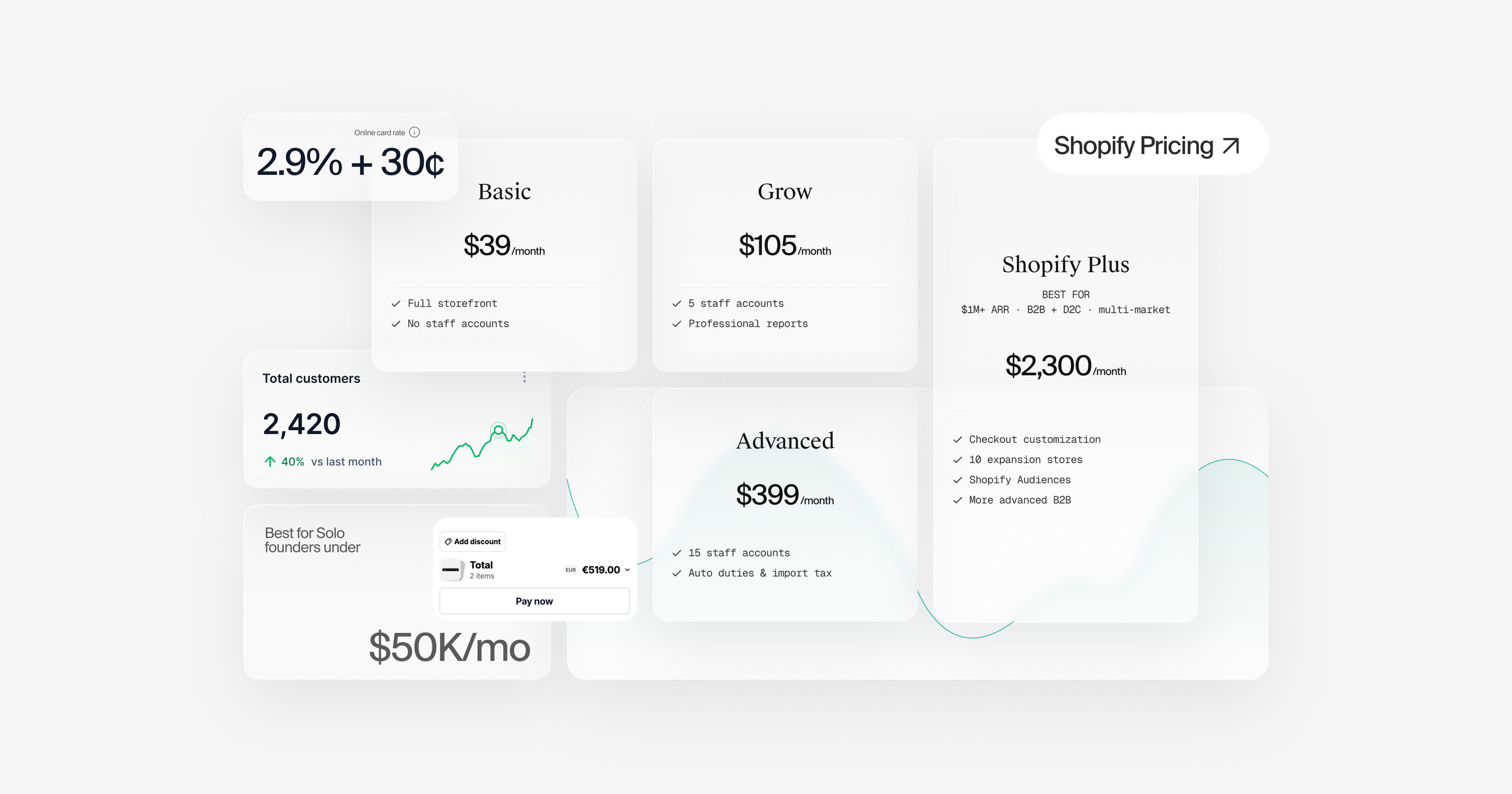
| Plan | Monthly | Annual (/mo.) | Online CC Rate | 3rd-Party Fee | Best for |
|---|---|---|---|---|---|
| Starter | $5 | - | 5% | - | Creators |
| Basic | $39 | $29 | 2.9% + 30c | 2.0% | New stores |
| Grow | $105 | $79 | 2.7% + 30c | 1.0% | Growing brands |
| Advanced | $399 | $299 | 2.5% + 30c | 0.6% | Scaling brands |
| Plus | $2,300 on 3-year, $2,500 on 1-year | Negotiable | ~2.15% + 30c | 0.20% | Mid-market & Enterprise |
Shopify Pricing Plans: Tier-by-Tier Breakdown
Starter: $5/month
This is not really a "store." It is a checkout link you can share on Instagram, TikTok, or WhatsApp. No full storefront, no theme customization, no real analytics. The transaction fee is 5%, which adds up fast.
Good for creators testing a product idea or someone selling merch through a link-in-bio. Not relevant for any brand seriously evaluating Shopify as a platform.
Basic: $39/month ($29/month on annual billing)
This is where Shopify becomes a real store. You get a full online storefront with themes, a blog, product management, and 24/7 support. The catch: no staff accounts. Only the store owner can access the admin. If you have even one team member who needs backend access, you are already looking at the next tier.
Credit card rates are 2.9% + 30c per online transaction through Shopify Payments. Use a third-party payment gateway instead, and Shopify adds an extra 2.0% on top of whatever your gateway charges. You also do not get real-time carrier-calculated shipping rates. That is an Advanced feature.
Best for: Solo founders or very early-stage D2C brands doing under $50K/month.
Back-of-napkin math: At $30K/month in revenue, you are looking at $39 in subscription fees + roughly $900 in credit card processing = about $939/month total. That is your entire platform cost.
Grow: $105/month ($79/month annual)
This is the plan most growing brands land on. You get 5 staff accounts, professional reports that actually tell you something useful, multi-market selling support, and up to 88% shipping discounts. Credit card rates drop to 2.7% + 30c, and the third-party gateway surcharge falls to 1.0%.
The jump from Basic to Grow is really about team access and data. The moment you have a marketing person, a fulfillment lead, or a co-founder who needs to log in, Basic does not cut it.
Best for: Brands doing $50K to $200K/month with a small team.
At $150K/month: $105 subscription + ~$4,080 in CC fees = ~$4,185/month.
Advanced: $399/month ($299/month annual)
Advanced is for brands that sell internationally or need serious reporting. You get 15 staff accounts, custom report builders, third-party calculated shipping rates (finally), and automatic duties and import tax calculation. The checkout can handle 10x the capacity of Basic/Grow, which matters if you run flash sales or have seasonal spikes.
This tier also gives you up to 3 markets included (scalable to 50) and 10 inventory locations. Credit card rates are 2.5% + 30c, and the third-party gateway fee drops to 0.6%.
Best for: Brands doing $200K to $800K/month, especially if you ship internationally.
At $500K/month: $399 subscription + ~$12,800 in CC fees = ~$13,199/month total. Sounds like a lot until you compare it to the self-hosted alternative.
Shopify Plus: $2,300-$2,500
Plus is where Shopify gets serious for bigger brands. The pricing structure is different: $2,300/month on a 3-year term ($2,500 on a 1-year term) as a floor, but once you cross roughly $800K/month in GMV, it switches to 0.35% of revenue, capped at $40,000/month.
What you get for that: full checkout customization through Checkout Extensibility (this is Plus-only, there is no way to customize the checkout on lower tiers), up to 10 expansion stores for different countries or brands, unlimited staff accounts, Shopify Flow for automation, a native B2B wholesale channel, dedicated support, and Shopify Audiences for ad targeting. Checkout capacity is 40x standard plans.For brands considering a headless architecture on Plus, the framework choice matters. We compared both options here: Hydrogen vs. Next.js: How to Choose a Shopify Headless Stack.
Shopify reports that merchants using Audiences see up to 50% lower customer acquisition costs, and published case studies back this up: Nathan James saw a 52% CAC decrease and 5.6x ROAS after switching to Audiences-powered targeting. For brands spending $20K+ per month on paid ads, that kind of reduction helps justify the Plus price tag on its own."
Credit card rates are negotiable at volume, typically around 2.15% + 30c. Third-party gateway surcharge is just 0.20%.
Best for: Brands doing $1M+ in annual revenue, anyone running B2B alongside D2C, multi-brand or multi-market operations.
At $2M/month GMV: ~$7,000/month platform fee (0.35%) + ~$43,300 in CC processing = ~$50,300/month. Yes, that is a real number.

↑ Shopify pricing, tier-by-tier
What You Actually Get at Each Tier
Price is only half the story. A lot of brands pick Basic because the monthly fee is low, then hit a wall two months later when they need staff accounts, or realize they cannot customize checkout, or find out Expansion Stores are only available on Plus.
| Feature | Basic ($39) | Grow ($105) | Advanced ($399) | Plus ($2,300+) |
|---|---|---|---|---|
| Staff Accounts | 0 | 5 | 15 | Unlimited |
| Reports | Basic analytics | Professional | Custom / Advanced | Custom + ShopifyQL |
| Checkout Capacity | Standard | Standard | Standard | 40x |
| Checkout Customization | No | No | No | Yes (Checkout Extensibility) |
| B2B / Wholesale | Yes* | Yes* | Yes* | Yes (Native B2B channel) |
| Expansion Stores | No | No | No | Yes (Up to 9 expansion stores) |
| Shopify Flow | Full access | Full access | Full access | Full access + advanced |
| Carrier-Calc. Shipping | No | No | Yes | Yes |
| Duties & Import Tax | No | No | Yes | Yes |
| Shopify Audiences | No | No | No | Yes (Included) |
| POS Pro | $89/mo per loc. | $89/mo per loc. | $89/mo per loc. | 20 locations free** |
*Disclaimer: As of April 2, 2026, Shopify made foundational B2B features available on all plans. However, advanced B2B capabilities (unlimited catalogs, partial payments, deposits) remain exclusive to Shopify Plus. Feature availability may change. Check Shopify's official pricing page for the most current plan comparison.**Unlimited POS Pro locations available for Plus merchants processing through Shopify Payments.
Shopify Fees Explained: Transaction Fees, Payment Processing & Surcharges
This section consolidates everything you actually pay per transaction.
| Fee Type | Basic | Grow | Advanced | Plus |
|---|---|---|---|---|
| Online credit card rate | 2.9% + 30c | 2.7% + 30c | 2.5% + 30c | ~2.15% + 30c (negotiable) |
| In-person credit card rate | 2.6% + 10c | 2.5% + 10c | 2.4% + 10c | Negotiable |
| 3rd-party gateway surcharge | 2.0% | 1.0% | 0.6% | 0.20% |
| Currency conversion fee | 1.5% | 1.5% | 1.5% | 1.5% |
| Shopify Payments requirement | No (but surcharge if not) | No (but surcharge if not) | No (but surcharge if not) | No (but surcharge if not) |
Quick rule of thumb: use Shopify Payments. It eliminates the extra transaction surcharge (0.2% to 2.0% depending on your plan). The only reason to use a third-party gateway is if Shopify Payments is not available in your market, or you have a specific contractual requirement with another processor.
At scale, the fee differences add up. A brand doing $500K/month saves roughly $1,000/month just by being on Advanced instead of Basic, purely from the lower credit card rate. That savings alone covers the plan upgrade three times over.
According to research Shopify commissioned from a Big Three consulting firm, Shop Pay converts up to 50% better than guest checkout, and up to 91% better on mobile.". That is not a cost reduction, it is a revenue increase, but it directly impacts your cost per acquisition and your effective transaction cost as a percentage of revenue.
Shopify POS Pricing: In-Store Selling Costs
If you have physical retail, or plan to, POS pricing is a big part of the equation.
POS Lite is free and included with every Shopify plan. Basic payment processing, product management, and customer tracking. Fine for a single location with simple needs or occasional pop-ups. But it does not do multi-location inventory, staff permissions, or buy-online-pick-up-in-store (BOPIS).
POS Pro costs $89/month per location ($79/month on annual billing). This is the real retail product. Multi-location inventory tracking, stock transfers between stores, staff roles and permissions, BOPIS, ship-from-store, and detailed sales reports by employee and location.
POS Pro on Shopify Plus: 20 locations included at no extra charge. For a brand with 10 stores, that is $890/month in POS fees you are not paying. That's $10,680/year.
| Scenario | Plan | POS Cost | Annual POS Spend |
|---|---|---|---|
| 1 pop-up shop | Basic ($39/mo) | $0 (POS Lite) | $0 |
| 3 retail stores | Grow ($105/mo) | $267/mo (3 x $89) | $3,204/year |
| 10 stores | Advanced ($399/mo) | $890/mo (10 x $89) | $10,680/year |
| 10 stores | Plus ($2,300+/mo) | $0 (20 included) | $0 |
For retail brands with 5+ locations, Plus can pay for itself through POS Pro savings alone, before you count the lower transaction fees.
When should you evaluate Shopify Plus?
Plus starts at $2,300/month on a 3-year term. That's a real number, and not every brand needs to pay it. Advanced at $399/month covers a lot. The question is whether you've hit the specific walls that only Plus removes. Here are the signals that you've outgrown Advanced.
You're expanding internationally and need separate storefronts
If your go-to-market strategy requires expansion stores (different brands, different regions, different currencies with localized operations), that's Plus territory. Shopify Markets handles a lot on lower plans, but when you need true multi-entity with separated stores, inventory, and pricing, you need the Plus organization structure. As Astrid from Shopify put it: four years ago, expansion stores were the only option for internationalization. Now Markets and multi-entity exist, but for complex international operations, Plus is still where you land.
You need checkout customization
This is one of the biggest myth-busters against the "Shopify is rigid" objection. On Plus, checkout extensibility lets you customize the checkout experience deeply without forking core code. Shopify Functions let you rewrite pricing logic, discount rules, and shipping calculations. If your business requires custom checkout flows, Plus is the only plan that gives you that level of control.We wrote a detailed breakdown of what this looks like in practice: Upgrading to Shopify Checkout Extensibility.
You're running serious B2B operations
As of April 2026, foundational B2B features are available on all plans. But advanced B2B (unlimited catalogs, direct catalog assignment to companies, partial payments, deposits) remains Plus only. If you're running wholesale with many buyer accounts and complex payment terms, the lower plans won't cover it.
Your integrations are hitting API limits
If you run a PIM, an ERP, or multiple data feeds that sync with your store, you'll hit API rate limits on lower plans before you hit them on Plus. For brands with complex tech stacks, this is the kind of bottleneck that slows down operations without anyone realizing why things feel sluggish. Plus gives you higher API rate limits, and for some brands, that alone justifies the upgrade.
You have 5+ retail locations
We covered this in the POS section, but it's worth repeating here. POS Pro costs $79/month per location on annual billing. Plus includes 20 POS Pro locations at no extra charge. A brand with 10 stores saves $9,480/year in POS fees on Plus. At that point, the POS savings alone close a meaningful chunk of the gap between Advanced and Plus pricing.
You want dedicated support
On lower plans, you get standard Shopify support. On Plus, you get a dedicated Merchant Success Manager. For brands running complex operations, having someone at Shopify who knows your account, your setup, and your roadmap is worth more than it sounds on paper. Especially during peak seasons or when you're mid-migration and something needs to be resolved fast.

↑ 6 signals you've outgrown Shopify Advanced
Costs most brands overlook when budgeting for Shopify
Third-party apps.
Shopify's subscription covers the platform. But every store runs apps on top of it, and those costs add up. This is one of the most common surprises for brands coming from monolithic platforms where "everything is built in" (until you realize how much you pay your dev team to maintain all those built-in features). Most mid-market brands spend $350 to $1,400/month on apps. Build that into your budget from day one, not halfway through a migration.
Here are the apps most brands actually run, with realistic monthly costs:
| App / Tool | What It Does | Approx. Monthly Cost | Notes |
|---|---|---|---|
| Klaviyo | Email & SMS marketing | $20 to $1,500+ | Scales with list size. ~100,000 contacts — about US $1,380/month |
| Rebuy | Personalization & upsells | $99 to $499 | AI-powered product recs, checkout upsells. $499/month includes: Full access to Rebuy’s personalization features (recommendations, upsells, cross-sells, smart cart, etc.). |
| Microsoft Clarity | Observability/Analytics | Free | Solid free analytics tool |
| CookieBot or you can also use out of the box cookie consent from Shopify | GDPR and ePrivacy compliant cookie solution | $34 Or Free | Required for EU compliance. |
| Global-e / Swap | Cross-border commerce | Revenue share model | Handles duties, localized pricing, local payment methods |
| Elevar (if youf you need near-perfect conversion tracking accuracy. Not required for most brands) | Data Tracking | $150 to $500 | First-party data for Meta, Google, TikTok ads. |
| Matrixify | Operations | $20 to $200 | Streamlines product updates and operations |
| Shopify Discounts | Native discount engine | Free | Built-in |
| Supaeasy | Discounts | $49 to $399 | For more advanced discounts |
| Swish (Wishlist) | Wishlists & save-for-later | $0 to $99 | Free plan available |
Payment processing fees.
If you use a third-party payment gateway instead of Shopify Payments, Shopify charges an additional 0.5% to 2% per transaction. Most brands commit to Shopify Payments during the sales process, then switch providers mid-implementation and get hit with fees nobody budgeted for. Decide on your payment setup before you sign, not during the build.
Implementation cost: design and development
There are two paths here, and the right one depends on where your brand is.
A ready theme ($150 to $400 one-time) with basic customization gets you live in two to three weeks for roughly $10,000 to $30,000. A custom build with a development partner runs $70,000 to $140,000 over 2 to 3 months. The theme route is faster and cheaper. The custom route gives you full control over performance, brand expression, and room to grow. It can also reduce ongoing app costs by building key functionality directly into the theme.
We wrote a detailed comparison of both approaches, including why we never build on pre-made themes: Why We Don't Build on Pre-Made Shopify Themes, and Never Will.
Don't forget to price in time. A Shopify Plus implementation typically runs 3 to 6 months. A Magento or Shopware replatform can run up to 18 months. Every extra month is a month you're paying for two platforms and delaying the revenue gains that come with a better storefront.
Why brands migrate to Shopify
Brands rarely replatform for fun. When they do, it starts with a number. The renewal quote, the hosting bill, the agency retainer, the total cost of keeping the current platform running. Someone adds it all up and realizes they're spending more to maintain the status quo than they would on a fully managed alternative.
The real trigger is when the platform stops being infrastructure and starts being a bottleneck. Every sprint goes to maintenance, patches, and keeping things running. Nothing goes to growth.
Three triggers that we see:
Cost of ownership
The platform renewal quote arrives and the number is higher than last year. But the sticker price is only part of it. Add the hosting bill, the license fee, the implementation partner's retainer, security patching, and DevOps salaries. Then add the costs that never make it into the spreadsheet: slow iterations because every change needs a developer, delayed campaigns because the sprint is full, and the lack of confidence to ship new features because on a self-hosted stack, even small changes carry real risk of breaking something in production.
When the CFO or Head of eCommerce adds all of that up and compares it against a fully managed platform, the gap is usually bigger than the pricing page suggests.
For some brands, the total spend doesn't drop after migrating. It shifts. The monthly platform cost goes up, but the OPEX disappears. The line items change, not necessarily the total. But the money that used to go to keeping things running now goes to a platform that runs itself.
The site went down when it mattered most
Black Friday traffic spikes. A flash sale goes viral. A celebrity post sends 10x normal volume to the checkout. The site crashes, or the checkout queues, or orders sit in limbo for hours. The lost revenue is real, but the bigger cost is what happens next: the team stops being aggressive with marketing because they don't trust the platform to handle the traffic. You stop running flash sales. You cap ad spend during peak. You leave money on the table not because of demand, but because of infrastructure.
If you don't trust your platform to handle your best days, it's the wrong platform.
Shopify's checkout handles around 4,000 checkouts per minute at baseline, and Plus customers get up to 40x that capacity. For brands coming off a failed peak, that number matters.
The team can't move fast enough
The marketing manager wants to launch a landing page, swap a hero banner, or test a new promotion. On a self-hosted platform, that requires coordination between your internal dev team and an external agency. Non-technical people can't own the content, can't move fast, and end up waiting on engineering for things that should take an afternoon.
The cost of being slow doesn't show up on an invoice. It shows up in revenue you never capture: campaigns that miss the window, tests that never ran, ideas that died in the backlog.
Common objections to migrating to Shopify
"We'll need apps for basic features and costs will add up"
This one has truth to it, but it's more nuanced than it sounds. Shopify covers more natively than most people expect. Search and filtering comes free through Shopify Search & Discovery. Basic subscriptions are handled by Shopify Subscriptions, also free. Loyalty can go surprisingly far with customer tags, segments, and Shopify Functions for discount logic. Reviews is the one category that genuinely needs a paid app from day one.
Where costs grow is when you outgrow the basics. A mid-market brand scaling up might run Klaviyo for email ($150 to $500/month), Yotpo or Judge.me for reviews ($50 to $300/month), Smile.io for a full points-and-tiers loyalty program ($100 to $400/month), and Algolia for advanced search and merchandising ($50 to $200/month). That's $350 to $1,400/month, but it's a scaling cost, not a launch cost.
Two trade-offs people miss. First, on a self-hosted platform, those same features exist as plugins or custom code that your team maintains, updates, and fixes when something breaks after a platform upgrade. That cost is hidden in developer hours. On Shopify, the app cost is visible and predictable. Second, because it's an ecosystem of independent tools, you're not stuck maintaining something that doesn't fit. If an app underperforms, you swap it. On a monolith, replacing a built-in feature means rebuilding it.
"We'll lose control over our infrastructure."
This comes up most with CTOs and technical directors whose job has been managing servers, deployments, and uptime. Moving to Shopify means handing that to a vendor. For some, that feels like giving up ownership.
The counterpoint: control over infrastructure is not the same as control over the business. The hours your team spends on server maintenance, security patching, and performance tuning are hours they're not spending on features that drive revenue. Shopify handles the infrastructure so your team can focus on the store.
"We'll pay extra fees if we don't use Shopify Payments."
This is real and worth knowing upfront. If you use a third-party payment gateway instead of Shopify Payments, Shopify charges an additional transaction fee on top of what your payment provider already charges. Depending on your plan, that ranges from 0.5% to 2% per transaction. On Plus, both the credit card processing rates and the third-party gateway surcharge are negotiable based on volume. On all other plans, the surcharge is fixed to your tier.
Most competitors don't charge this. It's one of the few areas where Shopify's pricing is less transparent than the rest of the market.
For many brands, Shopify Payments is the better deal anyway because the rates are competitive and you avoid the extra fee entirely. But if your business requires a specific payment provider for regional or contractual reasons, factor this into your cost calculation from day one.
"Migration will tank our SEO."
Every replatform causes a short-term drop in organic rankings. Google needs to reindex the new URL structure, follow redirects, and recrawl the site. This is true for any migration, not just to Shopify.
What matters is the recovery. With a proper redirect strategy and clean technical setup, most brands recover within 2 to 3 months. Some see improvements because Shopify's page speed and Core Web Vitals tend to score better out of the box than a legacy self-hosted stack.
Hidden costs of staying on a self-hosted platform
These costs don't always show up in a platform comparison because they're spread across departments, vendors, and contracts. They vary a lot depending on your setup and team size, but they're worth accounting for.
Hosting and infrastructure: $500 to $2,000+/month.
A mid-market brand on Magento or Shopware needs managed hosting, typically on AWS or Azure through a specialized provider. That covers your baseline traffic. Peak traffic (Black Friday, flash sales) is a separate problem. You either overprovision year-round or scramble to scale up manually. On Shopify, hosting is included and auto-scales.
DevOps and system administration: $1,000 to $5,000/month outsourced, or $60,000 to $120,000/year in-house.
Someone needs to keep servers running, apply security patches, configure caching, and respond when things break. For most mid-market brands, this is an outsourced team or a part-time responsibility spread across developers who could be building features instead.
Security and PCI compliance: $5,000 to $25,000/year.
If you accept card payments on a self-hosted platform, PCI DSS compliance is your responsibility. Security audits, penetration testing, vulnerability scanning. On Shopify, the platform is Level 1 PCI DSS compliant. Every store inherits that automatically. No audits, no extra cost.
When Shopify might not be the right move
We'd lose credibility if we didn't acknowledge the situations where Shopify is not the answer. Every platform has limits, and knowing where those limits are saves you more money than any pricing comparison.
Complex B2B operations. Shopify's B2B features are improving fast (foundational B2B is now available on all plans as of April 2026). But if you need highly specialized quoting engines, complex approval chains, punchout catalogs, or custom ERP integrations that go beyond what APIs can handle, a self-hosted solution might still be necessary.
Marketplaces. If your core business model is a multi-vendor marketplace where third-party sellers list, manage inventory, and fulfill their own orders, Shopify is not built for that. It's possible with apps and workarounds, but it's not native. That said, if you run an external ERP and Shopify serves as one sales channel within a larger ecosystem, that works. But as a standalone marketplace platform, it's not the right fit.
Full source code ownership. Some brands, especially in regulated industries, need to own every line of code and control exactly where their data lives. Shopify is a SaaS platform. You're renting, not owning. For most brands this is a feature, not a bug. But if your legal or compliance team requires full code ownership, that's a hard constraint no amount of TCO savings can override.
Brands that need everything fully custom at checkout. Checkout extensibility on Plus covers a lot. But if your business requires rebuilding the checkout from the ground up, redefining every step and every interaction, Shopify's architecture has boundaries.
If you're weighing Shopify but unsure about the architecture, we published a full breakdown of where each approach fits: The State of Shopify: Headless vs Liquid (Spring 2026).
Shopify Pricing FAQ
How much does Shopify take per sale?
On Basic using Shopify Payments, you pay 2.9% + 30c per online transaction. On a $100 sale, that's $3.20. On Grow, $3.00. On Advanced, $2.80. On Plus with negotiated rates, roughly $2.45. If you use a third-party gateway instead of Shopify Payments, add an extra 0.2% to 2.0% surcharge on top of your gateway's fees.
What is the cheapest Shopify plan for a real store?
Basic at $39/month ($29/month on annual billing). It's the cheapest plan that gives you a full online storefront. The $5/month Starter plan only gives you a checkout link, not a store.
How much does Shopify cost per month?
The platform fee ranges from $39/month (Basic) to $2,300+/month (Plus). But the platform fee is not your total cost. Add credit card processing (2.15% to 2.9% + 30c per transaction), apps ($350 to $1,400/month for most mid-market brands), and your theme or custom build. A realistic total monthly cost for a brand doing $150K/month on the Grow plan is around $4,200 to $5,500.
Is Shopify Plus worth it?
For most brands doing $1M+ in annual revenue, the math tends to work. The lower transaction fees, 20 included POS Pro locations, checkout customization, advanced B2B features, and Shopify Audiences can offset the higher subscription cost. If you're checking two or three of the boxes in our "When to evaluate Plus" section above, run the numbers for your specific setup. For many brands at that scale, Plus pays for itself. For others, Advanced at $399/month covers enough.
Does Shopify have hidden fees?
No. But three costs surprise most brands: third-party apps ($350 to $1,400/month), the extra transaction surcharge if you don't use Shopify Payments (0.2% to 2.0%), and implementation costs ($10,000 to $150,000 depending on theme vs custom build). None of these are on the pricing page. All of them should be in your budget.
Does Shopify charge transaction fees?
If you use Shopify Payments, you only pay the credit card processing rate (2.15% to 2.9% + 30c depending on your plan). No additional transaction fee from Shopify. If you use a third-party payment gateway, Shopify adds a surcharge of 0.2% to 2.0% on top of whatever your gateway charges. Most brands use Shopify Payments to avoid this.
How much does it cost to migrate to Shopify?
$5,000 to $15,000 for simple SaaS-to-SaaS migrations. $70,000 to $150,000+ for complex migrations from Magento or Shopware. $100,000 to $250,000 for enterprise Plus migrations with an agency. Timeline: 4 to 8 weeks for simpler builds, 3 to 6 months for Plus.
How does Shopify pricing compare to Magento or WooCommerce?
On sticker price, WooCommerce and Magento Open Source are "free." A study of 250+ enterprises found Shopify's total cost of ownership is 33% lower on average. WooCommerce's operating costs are 41% higher, and Adobe Commerce's platform costs are 42% higher than Shopify's when you factor in hosting, DevOps, security, and maintenance.
Is Shopify worth it for a small business?
If you're doing under $50K/month and selling primarily online, the Basic plan at $39/month is hard to beat. You get a full storefront, Shopify Payments, and 24/7 support without managing hosting, security, or infrastructure. The total cost (subscription + processing fees) on a $30K/month store is roughly $940/month. Compare that against the time and money you'd spend running WooCommerce or any self-hosted alternative, and the math works for most small businesses.


