21 Best Shopify Jewelry Stores: Real Examples for 2026
Jewelry is a $350–$400 billion global category, about one-fifth the size of apparel, yet growing faster. McKinsey’s State of Fashion 2026 projects jewelry unit volumes will increase by 4.1% annually through 2028, outpacing clothing in a cautious consumer environment.
The online opportunity is especially compelling. In 2025, only around 25% of global jewelry sales happen online, leaving 75% still taking place offline. That gap represents a major shift in progress, and a well-built Shopify store is one of the fastest ways to capture it.
This guide is for founders, agencies, and merchants studying the jewelry category on Shopify. You get 21 real store examples, what each one does well, where execution breaks down, and the patterns you can copy. If you are building or redesigning a Shopify jewelry store, start here and steal the bits that fit your brand.
Contents

TL;DR
- Jewelry is a $350–400B global category growing 4.1% a year, with only 25% sold online. Shopify stores are the fastest way to capture the shift.
- The best stores balance editorial art direction with commercial discipline. Pack-shots and lifestyle imagery, not one or the other.
- PDPs do the selling. Surface materials, sizing, warranty, and returns on the page, not in a footer policy.
- Video lifts conversion for anything above entry-level pricing. Use it to show motion, light, and how a piece sits on the body.
- Size and fit guidance is a trust feature. Get it wrong and you get returns.
- UGC and reviews work for accessible price points. Premium brands lean on craft, sizing accuracy, and service instead of star counts.
- Mobile performance is a conversion lever. Core Web Vitals first, animation second.
- Six patterns separate the best Shopify jewelry stores from the rest. The 21 examples below show what each looks like.
What makes a great Shopify jewelry store
A great Shopify jewelry store balances editorial art direction with commercial discipline. Jewelry is aspirational and sensory. Your store has to sell the object and the feeling around it. Six patterns separate the best work from the rest.
Art direction does the heavy lifting.
Jewelry photography needs two registers, and the best stores invest equally in both. First, clean pack-shots. Consistent background, controlled lighting, clear shadows, high-resolution crops that let a customer inspect the material. These are your catalog workhorses. They answer “what does this piece actually look like” and they have to be perfect. Inconsistent pack-shots make the whole store feel cheap.
Second, lifestyle and model imagery. This is where aspiration lives. A necklace on a model's collarbone, rings stacked on a hand reaching for a coffee, an earring caught in hair. Lifestyle shots give the customer a scale reference, a styling cue, and a reason to want the piece beyond its specs. The best stores alternate the two formats across the PLP and inside the PDP gallery. The common thread: a consistent visual system that earns the price point, and a deliberate rhythm between product and context.
PDPs are information-rich but never cluttered.
The Product Detail Page is where the purchase decision happens, and where you earn trust. Treat it like a consultant in a physical store answering every question a customer could ask: what it is made of, how big it is, how to care for it, what happens if it breaks, how fast it ships. Surface materials (recycled gold, solid vs plated), provenance, care, warranty, returns, and shipping directly on the PDP, not buried in a footer policy page. Every answer you bring up front removes a reason to hesitate. A lifetime warranty or a size exchange is a conversion lever, so put it where it can do its job. Use accordions or tabs to control density.
There are two viable approaches. Dense and organized, where every answer lives on the page and hierarchy keeps it readable. Or aggressively minimal, where almost nothing is visible and the imagery does the selling
Read more: How to build the best Shopify product page: a complete guide
Video on the PDP, where the price point justifies it.
For anything above entry-level pricing, product video pays back in trust. Use it to show motion, light, and how a piece sits on the body. This is where the emotional sell happens. A ring rotating in natural light. A chain catching movement against skin. An earring swinging as a model turns her head. Static images show the piece. Video shows how it feels to wear it, which is what jewelry shoppers need to imagine before they buy.
The research backs this up. Video keeps visitors on product pages for around 1 minute 34 seconds on average, compared to 38 seconds for static images which buys you more time to build the case. (Wistia State of Video Report). Process videos (how the piece is made, who makes it) deepen the brand relationship and work especially well for craft-led positioning.
Size and fit guidance built into the experience.
Rings need sizers. Chains and necklaces need length references. Earrings need scale shots on a model. The best stores pair sizing tools with clear reference imagery and, where possible, virtual try-on. Most stores can start with a clear size guide, consistent millimeter and inch measurements on every PDP, and one well-shot scale reference.
Speaking from experience: one of us at Commerce-UI once opened a ring box and found the diamond looking noticeably smaller than it did in the pack-shot. Not a great feeling, and one of the fastest ways to turn a delighted buyer into a return request. Scale references exist for exactly that moment.
UGC and reviews, especially for accessible price points.
For anything priced under a few hundred dollars, customer content is the strongest conversion lever you have. Pair two formats. First, a clear review section on the PDP with a star average, total count, and short written reviews. Keep it simple and visible. Second, UGC: Instagram-style video and photo where real customers wear the piece. Tie each UGC asset to a specific product so the link from inspiration to buy is one tap. At premium and fine jewelry price points, reviews work best when they focus on craftsmanship, sizing accuracy, and customer service rather than volume counts. Aspirational brands rarely push prominent star ratings on product cards because it shifts the feeling from premium to commercial. Know where on the price spectrum you sit, and match the social proof pattern to it.
Mobile performance and thoughtful interaction.
Most shopping happens on mobile, so performance is a conversion lever, not a nice-to-have. Core Web Vitals give you the scoreboard: Largest Contentful Paint (LCP) for load speed, Interaction to Next Paint (INP) for how fast the page reacts to taps, and Cumulative Layout Shift (CLS) for visual stability. Hit those benchmarks before worrying about anything else (more on Core Web Vitals). A small amount of well-optimized motion builds memory and product connection, but every animation should be measured against its cost to LCP and INP. Make sure the add-to-bag is always reachable, size selection is a single tap away, and the PDP never loses the conversion area below the fold.
These six patterns are the evaluation lens we used for the 21 stores that follow.
Tilly Sveaas
Visit Site: Tilly Sveaas
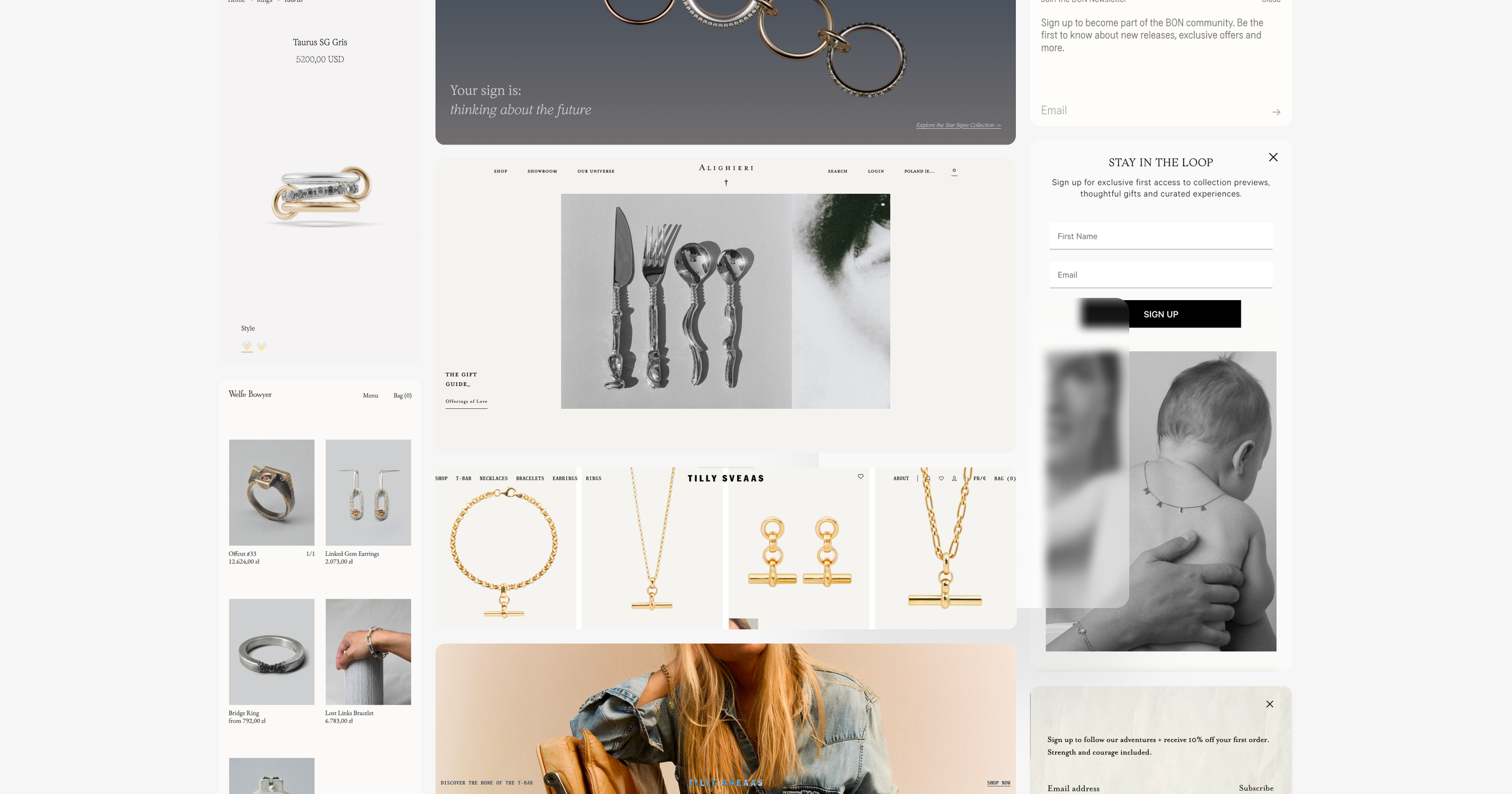
Tilly Sveaas is a London-based jewelry brand with an eclectic signature mix of links, chains and pendants, anchored by its iconic T-bar necklace. Where most luxury jewelry sites compete to be the most minimal, this one carries real character through a deliberate typeface choice, editorial layouts, and a T-bar motif woven throughout. Contemporary and design-led, but still timeless.
What stands out:
- T-bar motif woven through the whole site — used as a small explicit symbol, but also baked into section layouts that are literally built in a T-shape
- Typeface-led design: the character of the brand is carried by a single distinctive typeface choice rather than decoration
- Editorial layouts paired with minimal product cards — the PLP starts restrained, then opens up into editorial sections where the brand can breathe
- Original sketches and drawings of the pieces shown on the PLP, surfacing the craft behind each design
- PDP built around a fullscreen rotating gallery, with the conversion area blended into the gallery rather than boxed off from it
- "Shop the look" section that places other pieces in seamless context

PDPaola
Visit Site: PDPaola
PDPaola is an established global brand with a minimal aesthetic carried by a bold logotype. The design feels editorial, almost like a digital magazine, with overlapping sections and art-directed photography that rewards the care they put into imagery. Engaging without being heavy or laggy.
What stands out:
- Editorial box layout with overlapping sections that continues across sub-pages, adding subtle motion without slowing the page
- Art direction blends skin texture and sensuality with bold typographic details, creating a tension rare in the category
- PLP imagery alternates standard product shots with “get the look” styled images between cards, which keeps the grid interesting
- Bold logotype against a minimal body aesthetic gives the brand a distinct signature

Welfe Bowyer
Visit Site: Welfe Bowyer
A niche, premium approach built on deliberate negative space. Weflle Bowyer is not afraid to leave areas untouched, which creates tension and lets the content breathe. Typography is almost monastic, nearly a single size and weight throughout. Intentional and on point.
What stands out:
- Texture filter on the PLP (eroded, melt, natural), alongside standard material and category filters. We have not seen this anywhere else in the jewelry segment
- The texture taxonomy becomes a small emotional detail and a branded category unique to the store
- Editorial typography discipline: one font, one weight, used with confidence across the whole site
- Deliberate negative space signals premium without shouting

Mejuri
Visit Site: Mejuri
Mejuri reads as an established brand with heritage. Commercial art direction, high-quality but classic product photography, balanced by a few editorial shots that add personality. A solid, safe approach in a good way.
What stands out:
- Pairing a grotesque typeface with a monospace body font is an unusual and interesting combination
- Emotional editorial photography is used selectively to break up the commercial feel
- Strong overall polish on photography and styling
Watch out for:
- The headline serif feels like a default choice and reads hollow, especially in all caps
- Some section transitions pull headlines out of context, which creates an odd drop in hierarchy

Missoma
Visit Site: Missoma
Missoma communicates brand positioning through every detail, and the signals skew commercial. The mega menu with category images is a nice idea, and the UGC section connects shoppable products to Instagram-style video thoughtfully. Execution is uneven.
What stands out:
- UGC section ties user-generated video to specific products in a clean, scannable way
- Mega menu surfaces lots of categories with contextual imagery
Watch out for:
- Too many typographic styles. Two typefaces in theory, but with so many variations and a decorative serif for headlines, it feels cluttered
- Mega menu thumbnails are too small to recognize the products, which defeats the purpose
- Star ratings are pushed hard on product cards. Aspirational brands rarely do this because it signals commercial over premium
- Corner radii differ across components, spacing is uneven, and the homepage icon section looks undesigned

Astrid & Miyu
Visit Site: Astrid & Miyu
A strong concept with uneven execution. The hero video communicates stacking charms immediately, and the product card interaction is genuinely original. Some finishing details undermine the whole.
What stands out:
- Product cards morph from a rectangle into a geometric shape on hover, cropping the image differently. A nice play on geometry
- The shape shift works like a subtle visual blur, catching the eye without being obvious
- Hero video does a lot of merchandising work in a few seconds
Watch out for:
- Typography feels dated, closer to 2015 or 2016 than to current editorial jewelry
- Hover transition on product cards is too slow, which reduces the impact
- “Shop the look” hover panels go out of viewport, a real UX issue
- Iconography is inconsistent: different stroke weights across the same section

Ana Luisa
Visit Site: Ana Luisa
Commercial from the first second. Large buttons, a static hero, a mega menu built for scale. The customizable configurator is ambitious but the layout wastes space.
What stands out:
- Well-structured mega menu with imagery, important for a store of this size
- Configurator concept for multi-stone chains is a strong idea
- Video content on the PDP lifts the experience
- Interesting ideas around personalized discounts and coupons
Watch out for:
- Static hero where a video would add real engagement
- Configurator pushes everything to the left with a large empty column on the right that serves no editorial purpose. White space only works when it balances, not when it reads as unfinished
- Personalization ambition is not matched by aesthetic execution

BON
Visit Site: BON
Editorial and content-heavy, and the content is strong enough to carry the weight. Minimalism echoes the products. One of the best-balanced PDPs in the review.
What stands out:
- PLP breaks into actual category sections (charms, chains) instead of a filter bar. Inside each section you can switch material context without reshuffling product positions. Seamless, and avoids the usual jarring filter experience
- PDP is a great example of balanced white space: emphasis on the main image, conversion content well-proportioned, nothing feeling crowded
- Vertical cross product displayed in a vertically emphasized layout. Small detail, big difference
- Shoppable journal pairs founder and artist interviews with the ability to shop pieces from those stories
- Animated gemstone gif in the footer that cycles through colors is a contemporary touch

Aurate
Visit Site: Aurate
Not editorial, but it works. The PDP is one of the stronger ones in the review: dense with buyer-relevant info, organized with accordions so density never overwhelms.
What stands out:
- PDP surfaces lifetime warranty, size exchange, and in-stock notifications clearly, without clutter
- Accordions control information density well
- Process video makes the brand feel personal and approachable, and builds a more intimate customer relationship
- PLP uses large category imagery to guide navigation
Watch out for:
- Oversized hero banner does not feel contemporary
- Countdown timer for a sale sets a commercial tone the rest of the site has to fight
- Product photography art direction is inconsistent: shadows missing on some cards, different on others
- Process video does not sit cleanly with the commercial tone elsewhere

Minsai
Visit Site: Minsai
A case where creative vision outpaces structural execution. The art direction is genuinely interesting, but image quality and layout details undermine it.
What stands out:
- Mystical product photography with obscured models, red dots, and natural displacement. A clear creative vision
- Gallery-style PLP with a full-screen tiled grid where product info appears on hover. More gallery than product grid, and distinctive
- Video elements show process well and are well filmed
Watch out for:
- Logotype does not sit well with the rest of the art direction
- Some images are noticeably pixelated, which kills the creative idea technically
- Mega menu lacks images, making navigation harder
- PDP layout and button hierarchy feel awkward despite strong visual content

Miru
Visit Site: Miru
Strong features undermined by friction. The quick view pattern is an interesting idea, and variable grid density is useful, but a few decisions work against conversion.
What stands out:
- Switchable grid density on the PLP: larger and smaller card views
- Quick view overlay from the PLP could work as a quick-buy pattern for customers buying multiple pieces in one session
- Industry-standard, near-render-quality product imagery
Watch out for:
- Full-screen coupon pop-up on arrival forces an interaction before any browsing can happen
- Smallest PLP list view removes product names and prices, a usability problem
- Quick view adds an extra click before the real CTA, which hurts conversion. For higher-priced jewelry, customers usually want more context before buying, so this pattern works against the stor

Spinelli Kilcollin
Visit Site: Spinelli Kilcollin
A strong combination of commercial viability and distinctive art direction. Rare technical ambition for the jewelry segment.
What stands out:
- WebGL interactive experience: you can move through 3D space and explore individual charms. Technically rare in jewelry
- Dual categorization: shop by product type (rings, earrings) or by named collection (Star, Art, Wedding). Collection PLPs are laid out editorially, curated for mood even when inventory overlaps. A smart way to create multiple entry points into the same catalog
- Short video loops instead of static images on some PLP products, which adds a premium quality signal
- Pill-shaped category buttons are more visually interesting than standard square buttons or text links
- Bold editorial imagery on the homepage paired with refined product photography

Vitaly
Visit Site: Vitaly
100% Y2K, Gen Z e-commerce. The brutalist aesthetic is the intent, using raw stroke-based elements. They know their audience.
What stands out:
- Clear audience targeting with bold, raw visual language that lands with a younger demographic
- Stroke-based brutalist elements used as an intentional system
Watch out for:
- They played it safe. The direction is brutalist on the surface, but execution sits in an inconsistent middle ground: not clean enough to be refined, not raw enough to be compelling
- Some elements feel accidental rather than intentional, which undermines the aesthetic
- Typography is too conservative for the direction. It should carry more of the visual load

Ring Concierge
Visit Site: Ring Concierge
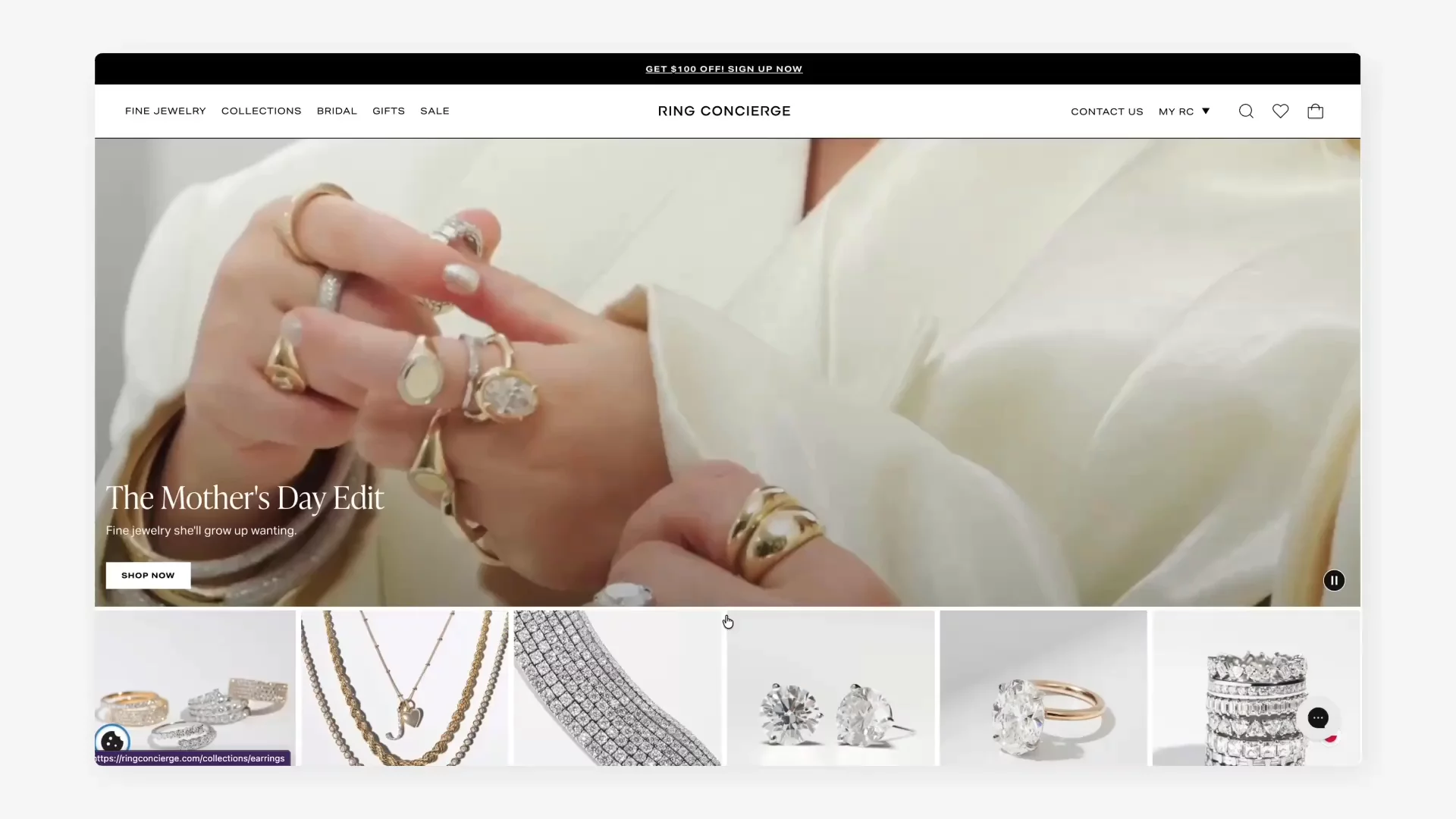
Commercial positioning done well. Strong structural choices around navigation and PLP usability.
What stands out:
- Non-standard hero aspect ratio frames a necklace in an elongated photograph, which suits the product
- Full range of product categories appears as cards within the hero section itself, so you can start navigating immediately without scrolling
- Variant selector visible directly on the product card shows available sizes and materials without going to the PDP, which reduces frustration
Watch out for:
- Collection PLPs have no editorial layout, they are just standard grid pages
- Standard PLP otherwise
Daisy
Visit Site: Daisy
Maximalist, content-dense, and mostly held together by well-placed white space. A few design-system cracks and a layout bug undermine the polish.
What stands out:
- Analog-quality hero video is genuinely distinctive
- Maximalist stacked sections work because white space punctuates them in the right moments
- High content density without feeling overwhelming
Watch out for:
- On the PDP, the product name is barely larger than the accordion labels, which weakens hierarchy
- Square PLP cards do not suit chain and necklace products. A 4:5 or taller portrait ratio would read much better
- Hovering on a first-row product triggers a layout shift that pushes the second row down, creating a shutter effect that undermines polish

Sarah Eisman Studio
Visit Site: Sarah Eisman Studio
One of the most considered sites in the review. The art direction earns the price point, and some pieces run close to $14,000.
What stands out:
- 3D renders in a transparent, negative-space style sit alongside black and white photography, giving the site an archival, catalog-like quality
- Typography reads almost like a physical printed manual
- PDP uses technical sheet-style boxes to present high-end contemporary jewelry. An unusual contrast for the category, and it works because no one else presents jewelry this way
- Grotesque typography with considered spacing and positioning, without using any decorative typeface
- Craft in the art direction and layout justifies the premium positioning

INO
Visit Site: INO
A bold, polarizing PDP bet: hide everything, let the imagery sell. It works here because the imagery is strong enough to hold it up.
What stands out:
- Striking, distinctive photographic direction. The kind of imagery you remember
- Aggressively minimal PDP: on arrival, almost no information is visible. A small block in the bottom right corner shows name and price. Clicking “details” expands to reveal size and add-to-bag
- The futuristic, space-capsule feeling is intentional and coherent
Watch out for:
- Add-to-cart is hidden by default, against standard e-commerce practice. The approach bets entirely on imagery & art direction to sell. It only works with exceptional content. Without it, the experience collapses

Alighieri
Visit Site: Alighieri
The highest attention to detail of any site in the review. Reads like a different era, with confident typography and analog, painterly imagery.
What stands out:
- Analog, film-shot photography with surrealist moments that read almost like paintings
- Typography choices feel unusual and cohesive, creating strong contrast with the personality-free default of most jewelry brands
- Execution matches the idea at every level. Nothing feels out of place
- Sales facts at the bottom of the page pair with abstract drops of gold instead of generic icons, reinforcing the brand's character rather than defaulting to e-commerce conventions

Nima Kaufmann
Visit Site: Nima Kaufmann
A great example of combining analog and digital in a memorable way. Not conventionally user-friendly, but unforgettable.
What stands out:
- PLP is the most memorable part of the site. Products are revealed one at a time in a projector-like looping sequence, almost like slides in a cinema
- Switching categories does not reload a new grid. The loop continues and expands the relevant category, maintaining the film metaphor throughout navigation
- Completely against standard UX practice, and that is the point

Bypariah
Visit Site: Bypariah
Editorial meets commercial. Refined and clean product photography, carried by strong structural choices and consistent imagery.
What stands out:
- Logotype slices through the layout. A strong detail, and it would be even stronger with a pixel-perfect line alignment against the images
- Commercial enough to convert, minimal and editorial enough to feel premium
- Solid reference for how to stay commercially accessible without sacrificing aesthetics

Sarah & Sebastian
Visit Site: Sarah & Sebastian
Memorable, tactile, and technically ambitious. The chain configurator is one of the most distinctive interactions in the review.
What stands out:
- Scrolling logotype overlaid on the hero photograph, in green, echoes the green jewelry in the collection. A deliberate material connection
- Left-side drawer navigation reads like a magazine layout
- Typographically more interesting PLP than most in the segment
- Chain configurator: select individual letter pendants from an alphabet display and add them to a chain. When a new pendant lands, the chain physically wiggles, simulating weight and movement. Rare on screen
- Journal section reads like a printed magazine layout, not a content blog

Cross-store patterns worth stealing
A few things came up repeatedly across the 21 stores. Use this as a checklist when you audit your own Shopify jewelry store.
- Video on the PDP. Aurate, Astrid & Miyu, Spinelli Kilcollin, Ana Luisa, and Minsai all lift their experience with video. For higher price points, the investment pays back in trust.
- Editorial PLP breaks. PDPaola, BON, and Spinelli Kilcollin all break up the product grid with editorial or “get the look” content. It keeps the grid interesting without hurting scannability.
- Branded filters and taxonomy. Welfe Bowyer's texture filter and Spinelli Kilcollin's named collections show how taxonomy itself can become a brand asset.
- White space as intentional design, not absence of content. BON and Sarah Eisman Studio use negative space as a signal of craft. Ana Luisa shows what happens when white space is not balanced: it reads as unfinished.
- Information architecture on the PDP. Aurate's accordion pattern for trust and policy content keeps density manageable. Copy it.
- Tactile interactions. Sarah & Sebastian's wiggling chain and Spinelli Kilcollin's WebGL prove that small physical metaphors make the experience memorable in a category that rewards memory.
About the contributors
This article was written with insights from the Commerce-UI design team. Big thanks to Marco and Antuk.
Commerce-UI is a boutique Shopify Plus agency. It specializes in designing and building eCommerce experiences for global premium brands including Lady Gaga, Magda Butrym, Pangaia, Nour Hammour, Chantelle, Aether Apparel, and Oura Ring. Our work has been recognized internationally, including honors at The Webby Awards and the “Best Custom Shopify” award in Toronto.
See our work.


