eCommerce GEO: How to Rank in ChatGPT, Perplexity and Google AI
Search demand for “generative engine optimization” has climbed to roughly 12,000 US searches a month this year, up from near-zero eighteen months ago. For eCommerce brands, this shift has a name: eCommerce GEO.
Shopify’s own Q1 2026 numbers, drawn from millions of merchant sessions, show that AI-referred shoppers convert about 50% higher than organic search, spend 14% more per order, and drove orders that grew nearly 13x year-over-year. Across 25 merchant categories, AI referrals outperformed organic SEO in 23 of them, by an average of 56% (Source: Shopify AI Search Insights, Q1 2026).
So the real question is not whether AI shopping matters. It is whether your store shows up in it. When a customer asks ChatGPT, “what’s the best running shoe for flat feet under $150,” does your brand come up in the answer? If you can’t answer that today, you have a measurable revenue gap opening up.
This is the eCommerce GEO playbook: what GEO is, how to measure whether AI is finding your store, and the concrete moves that get your store cited in AI answers.
Contents
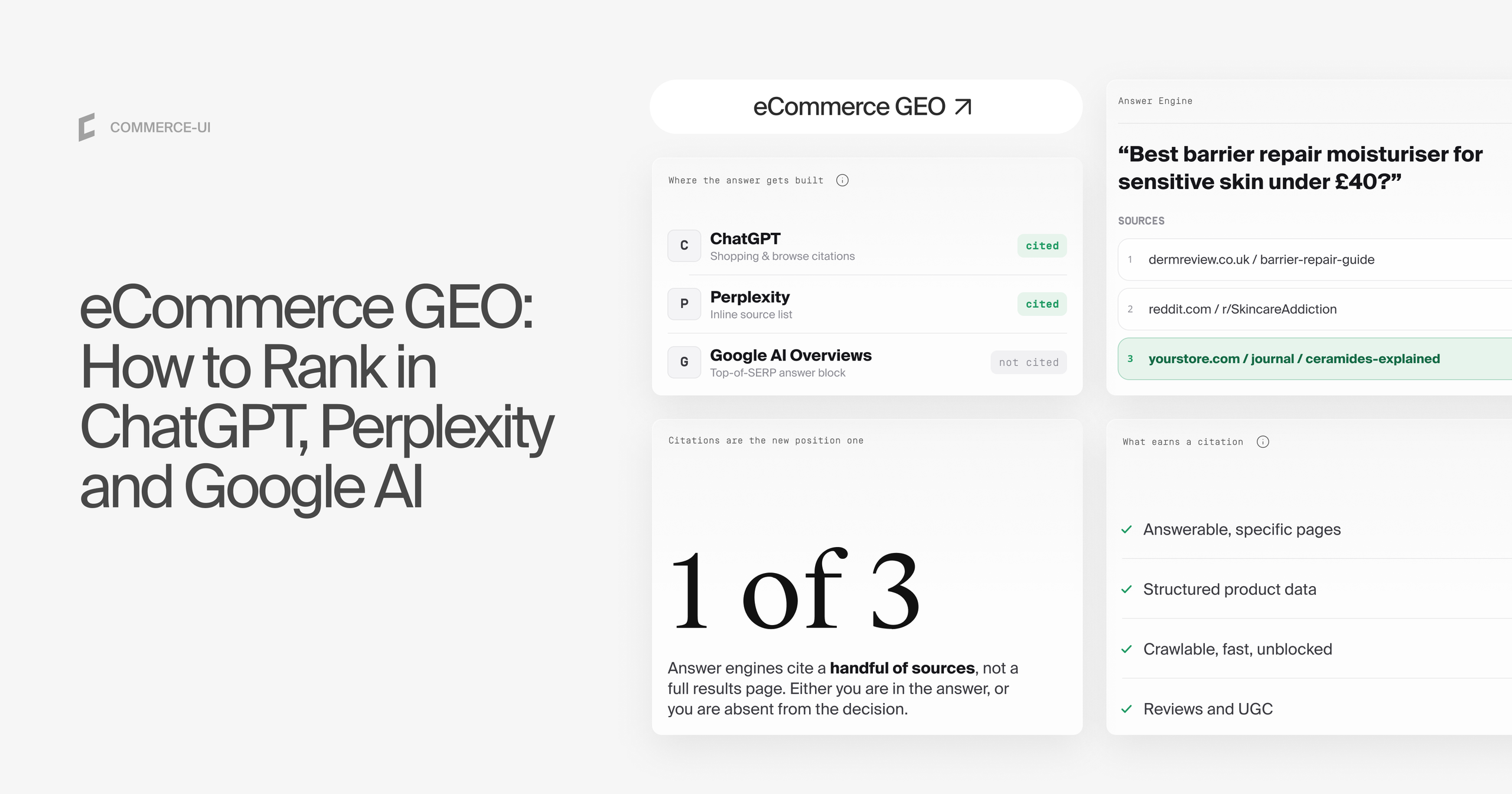
↑ Diagram explaining eCommerce GEO: how ChatGPT, Perplexity, and Google AI Overviews cite a small set of sources, and what earns a brand its citation.

What GEO actually is, in 90 seconds
Generative Engine Optimization (GEO) is the work of making your brand visible and cited inside AI-generated answers. It is what SEO was for Google’s classic search results page, adapted for a world where AI writes one paragraph instead of showing ten links.
You will see two acronyms floating around:
- GEO (Generative Engine Optimization) is the umbrella term.
- AEO (Answer Engine Optimization) is the question-answering subset of GEO.
Search results are being replaced by synthesized answers. The question you should be asking yourself is whether your brand is in them.
The change matters most for eCommerce. When someone asked Google for “running shoes for flat feet,” they got ten links on a results page, browsed a few, and clicked. When they ask ChatGPT, they get one paragraph naming two or three brands. Everything else is invisible. The click does not happen unless you are in that paragraph.
GEO vs SEO: same goal, different game
There is a simple way to hold the difference:
SEO answers keyword searches. GEO answers use-case descriptions.
In classic SEO, you optimize for a query like “black leather boots men size 11.” You want to rank number one on the results page for that keyword. The customer clicks, lands on your PDP, and buys.
In GEO, the customer no longer types keywords. They describe a use case: “Find me waterproof leather boots for a European size 11 wide-fit that will handle city walking in rain, delivered before December 3rd.” An AI agent takes that request, fans it out into dozens of parallel queries, hits many sources at once, and returns a single synthesized recommendation. The customer never sees a results page. They see one answer.
The ranking signals change accordingly.
SEO signals:
- Keywords and page relevance
- Backlinks and domain authority
- Page speed and technical metrics
Focus: earning clicks. Metric: pageviews and rankings.
GEO signals:
- Credibility and source authority
- Structured data and API accessibility
- Off-site citations from communities, reviewers and publications
Focus: getting recommended. Metric: AI mentions, citations and referrals.
The two overlap more than the acronym fight suggests. Traditional SEO ranking still correlates strongly with AI citations. Shopify ran a test on 63,000 fan-out queries generated from 17,000 prompts in Gemini, and the pages that ranked in the top few SEO positions were the pages AI assistants cited most. If your classic SEO is strong, GEO comes largely for free. If your SEO is mid-tier, that is where you invest first.
But there are new demands SEO never made: structured, machine-parsable data; off-site citations from Reddit and forums; reviews on every PDP; About Us pages that carry brand story clearly. Those are the new demands that classic SEO alone doesn’t cover.
Why this matters more for eCommerce than for B2B SaaS
Most GEO content on the internet is written for service businesses (find me a plumber, find me a therapist, find me a marketing consultant). For eCommerce, the stakes are different, and higher.
Product discovery is where AI assistants are moving fastest. ChatGPT rolled out native shopping. Perplexity has its own shopping experience. Google’s AI Overviews now surface product carousels alongside text answers. Meta announced integrations. In an AI-mediated shopping trip, the consumer does not browse. They describe what they want, and the AI narrows the field for them.
Once your brand is not in the consideration set that comes back, the click never happens. You do not get to compete on price or messaging or urgency at the top of the funnel, because the funnel starts inside the AI. The AI already narrowed the choices before the shopper saw them.
One nuance worth flagging. Shopify’s own field data suggests younger and mid-professional shoppers are adopting AI-mediated search fastest, but older demographics are catching up quickly as ChatGPT and Perplexity get easier to use. The lazy read that says “AI shopping is a Gen Z thing” is already out of date.
Two forces make this urgent for DTC brands under $50M.
Traffic is moving away from you. Analysis from Yotpo across their customer base shows sites under $10M in revenue are losing 40 to 70 percent of organic traffic. Mid-market sites ($10M to $100M) are losing 35 to 40 percent. The click-to-your-site model that fueled DTC for a decade is compressing.
But intent is moving toward you. Purchases driven by AI-powered search have grown roughly 11x since January 2025, and orders from AI sessions carry around 30 percent higher AOV. Fewer sessions, but the sessions that do land are highly qualified. (Source: Yotpo CommerceGPT Analysis, 2025, presented at Shopify’s NRF 2026 talk “A practical guide to AI discovery.”)
Less traffic, higher intent, bigger baskets. That is the paradox to plan for.
How AI assistants actually source product information
An AI assistant recommending a product has three ways to get the product information it needs. Understanding all three shapes what you invest in.
Path 1: Live web retrieval
When Perplexity, ChatGPT browse, or Google’s AI Overviews need current data, they issue live web requests. That is a modernized version of crawling. Your webpage is scraped in real time, parsed on the fly, and the useful bits are fed to the answer. This is why lazy-rendered content on your PDP hurts you. Accordions are fine as long as the content ships in the initial HTML and is only visually collapsed. It is the pattern of loading content only when the user clicks that breaks live-retrieval agents: they never trigger the click, so they never see the content.
Path 2: Training data
LLMs are trained on a snapshot of the internet up to a cutoff date. If your brand was well-cited across the web when the model was trained, you are baked in. If you were not, catching up requires either time (for the next training cycle) or citations that make you retrievable via Path 1.
Path 3: Direct data feeds
This is the newest and most consequential path. Instead of reading your webpage, the AI is handed a clean, structured data feed. In Shopify’s world, that is the Global Catalog: the product database sitting behind a purpose-built search API for AI agents.
The clearest way to hold the model is as infrastructure. Imagine your product data as a truck. That truck is the Global Catalog. The Search API on top of it is the ramp that lets AI agents drive into your warehouse and grab what they need. And the language they use to talk to your catalog, and every other merchant’s catalog, is Shopify’s Universal Commerce Protocol (UCP). UCP is the street network that connects the agents to the ramp, to the truck, to your products.
Then there is the activation layer for merchants: Agentic Storefronts. A toggle in your Shopify admin that says “yes, sell my products through AI agents.” Turning it on syndicates your product data across Google, Microsoft Copilot, ChatGPT, and every future AI channel plugged into UCP.
For merchants not on Shopify: the Agentic Plan
Merchants who are not on Shopify have not been left out. The recently announced Agentic Plan is a Shopify “shell,” essentially a lightweight Shopify admin, that a Magento, Shopware, or custom-platform merchant can push their products into, without a full replatform. You get access to the same agent infrastructure without migrating your main store.
What this shift means for your architecture is the following.
- If you are on Shopify and using core Shopify features, most of this happens automatically once you enable it. Product data flows into the catalog, API access is handled, agent access is one toggle.
- If you are off-Shopify or your product data lives in an external PIM feeding a custom frontend, you have work to do. You will need to manually connect your data to UCP, which means developer time. It is doable, but the cost curve is much higher.
Path 3 is where AI shopping is heading. Live web retrieval will still exist as a fallback (agents will keep scraping the open web for sites they cannot reach directly), but the direct-feed model is faster, cleaner, and, crucially, gives the agent authoritative price and availability. When live scraping goes wrong, agents pass stale prices, wrong stock, wrong shipping cutoffs, wrong tax. That leads to failed payments and unhappy customers. Which is why Shopify (and others) are pushing hard for merchants to plug into the API layer.
We’re making every Shopify store agent-ready by default.
Tobi Lütke, CEO of Shopify
The eCommerce GEO playbook: 8 things to fix this quarter
Below we’ve gathered eight tangible action points worth having a look at. Nothing here is revolutionary on its own. What matters is the order you tackle them in, and why each one helps you get cited in AI answers. Take what fits your store, park the rest.
6.1 Product schema that LLMs actually parse
Structured data is the number-one on-site signal agents look for. The minimum is a valid Product schema with Offer, AggregateRating, Review, Brand, and Audience populated. Add GTIN (the product’s barcode number) and MPN (Manufacturer Part Number) where available. Both are standard Schema.org fields used by Google Shopping and by AI agents to identify exact products across the web (source: Google Search Central product structured data guidance). Add BreadcrumbList for context, and FAQPage schema (the Schema.org markup type for FAQ pages) where you have real FAQs on the page.
If you are on a Shopify theme with proper structured data, you are 80% of the way there. If you are on a headless build, verify the JSON-LD is rendered on the server and ships in the initial HTML. Client-side injection of schema is a common headless mistake. Google’s crawler will typically render JavaScript and pick up JS-generated schema. AI bots like ChatGPT and Claude usually do not. If your schema depends on JavaScript to appear, the bots that decide whether to cite you will miss it. (Source: Google Search Central structured data guidance.)
6.2 PDP copy patterns that get cited
Copy that gets cited by AI answers has a different shape than copy written for a human browsing.
- Question-and-answer phrasing. “Is this shoe good for flat feet?” gets cited more than the same information buried in a paragraph.
- Comparative language. “Wider toe box than the Nike Pegasus” surfaces on comparison prompts.
- Specifics over adjectives. “Weighs 249g in size 10” beats “lightweight construction.”
- Use case tags. “For daily runs of 5-10km” is exactly what a fan-out query is looking for.
The rule of thumb: write for the shopper who is having a conversation with an AI, not the shopper skimming a product page. They will ask attribute-specific questions. Answer them on the page, in text a machine can find.
6.3 Collection pages that match category prompts
Prompts like “best running shoes for flat feet” hit collection pages before they hit PDPs. That means the collection page needs its own content, not just a filtered product grid.
Write a short intro (150 to 250 words) that names the use case. Include a comparison table or a small buyer’s guide inline. Add FAQPage schema at the bottom for the two or three most common category questions. Make the sort and filter logic accessible to crawlers, not just clickable in JavaScript.
6.4 FAQ and Q&A blocks in the right place
Two rules:
- Wherever you have real FAQs (sizing, care, warranty, shipping), mark them up with FAQPage schema. Agents pull FAQPage answers heavily.
- Never hide FAQs behind accordions with the answer only rendered on click. The answer must be in the initial HTML.
The old UX pattern of collapsing FAQs to save vertical space is fine, as long as the answers still ship in the initial HTML. If the accordion only loads its content on click, you lose it.
6.5 Reviews and UGC, structured
This is the most under-leveraged GEO asset in eCommerce, and it is also the one AI trusts most.
The Shopify frameworks are consistent on this point. LLMs prioritize user-generated content above brand-owned content, and prioritize it above influencer and media coverage too. When an agent asks “is this product good?”, it wants to hear from customers.
What this requires:
- Reviews on every PDP with structured markup. AggregateRating and Review schema at minimum.
- Recent reviews. Reviews decay. A product with 200 reviews from three years ago and none in the last twelve months signals stale.
- Specific reviews. “Fits my flat feet perfectly for 10km runs” is worth ten “Love it, 5 stars.”
- Visual reviews. Photos and videos.
- Q&A on the page. A visible customer Q&A section is a citable UGC source.
6.6 Brand mentions across third-party sites (the citation graph)
Shopify’s data suggests roughly 70% of the citations AI agents pull come from outside your store. Your PDPs matter. But Reddit, Wikipedia, YouTube, Wirecutter-style category reviewers, gear labs, forums, and analyst notes matter more in aggregate.
Investing here is not a marketing brand exercise. It is an infrastructure play for AI visibility. Priority order:
- Reddit AMAs and category subreddits. Agents pull heavily from Reddit. A well-run AMA is one of the highest-yield GEO investments a brand can make.
- Category expert coverage. Wirecutter, Runner’s World, Consumer Reports, or the niche equivalent for your category.
- Media and PR mentions. Reputable trade press, analyst notes.
- YouTube reviews. Independent reviewers with actual footage of the product.
Traditional PR work suddenly matters again. Not for the backlink, but because the citation is what an agent uses to say “brand X is the trusted answer here.”
6.7 Headless and SSR
This section is drawn from Commerce-UI’s own rebuild experience across Hydrogen storefronts, backed by Shopify’s Hydrogen documentation. If you are on a headless stack, two specific things will break your GEO if you are not careful.
Server-side rendering. Anything meaningful must be in the initial HTML response. If your product spec table only renders after a JavaScript bundle loads, an agent doing live retrieval sees an empty div. SSR everything that matters for citation: PDP body copy, price, availability, review data, structured data, breadcrumbs.
Structured data rendering. JSON-LD injected client-side will not be read reliably. It must ship with the HTML.
For Shopify Hydrogen builds this is a solved problem if you deliberately handle it. On custom React storefronts, it is often the gap between “we have GEO” and “we don’t.”
We wrote a deeper piece on State of Headless Shopify.
6.8 robots.txt and AI crawler user agents
Some brands panic about AI training and preemptively block all AI user agents in robots.txt. Do not. Blocking GPTBot, ClaudeBot, PerplexityBot, Google-Extended, and their peers means blocking yourself from the answers those AIs generate.
The right posture: allow the retrieval agents (they need to read you to cite you), and disallow training agents only if you have a specific business reason. If you are not sure, allow everything, and revisit only if you see abuse patterns in your logs.
Also add an llms.txt file at the root of your site. It is an emerging standard for telling AI agents which content on your site is public and citable. Low cost, and it signals you are paying attention.
If you are on Shopify, you get more out of the box. Shopify auto-generates sitemaps optimized for AI crawlers, both the standard sitemap.xml and a dedicated sitemap_agentic_discovery.xml. Shopify themes now also support an agents.md file, which is a plain-text place to describe your brand, product categories and buying rules specifically for AI agents. Use all three.
Shopify docs on the agents.md template.
How to measure GEO
Measurement is early. Anyone telling you otherwise is selling you something. Three approaches, in rising order of maturity.
Approach 1: Manual prompt audits
Pick 20 to 40 prompts a real customer would say. Run them against ChatGPT, Perplexity, and Google’s AI Overviews weekly. Log whether your brand is cited, which product, and against which competitors. It is tedious. It also works, and it is free.
Approach 2: Fan-out query rank tracking
This is the method Shopify presented at their OMR 2026 masterclass. It is the most actionable technique in the deck, and worth replicating exactly.
- Pull your list of most important URLs and their top-ranking keywords from your SEO tool.
- For each URL and keyword pair, generate a prompt an AI shopper would actually say.
- Run that prompt in Google AI Studio. It exposes the fan-out queries the model spawned.
- Copy those child queries.
- Add them into your classic SEO rank tracker (Ahrefs, Semrush, etc.) and monitor rankings as if they were normal keywords.
The insight: if you rank on the AI’s fan-out queries, you show up in the AI’s answer. If you do not, you do not. Rank tracking still works, you just have to know which queries to track.
Approach 3: Purpose-built AI visibility tools
- Ahrefs Brand Radar for share-of-voice tracking across AI answers, plus affiliate and citation channel discovery.
- Profound, Athena, AthenaHQ, Peec AI, Otterly for AI answer monitoring.
- CommerceGPT for a Shopify-specific AI visibility score.
For merchants on Shopify with Agentic Storefronts enabled, your Shopify admin already surfaces orders and customers coming in through agent channels. That is your ground truth for the revenue side. Everything else feeds into it.
The Agentic app inside your Shopify admin is where this shows up. Pair one of these tools with the fan-out ranking method, and you have both leading and lagging indicators. Rankings tell you what is coming. Revenue tells you what landed.
What we tell our Commerce-UI clients
Our 90-day plan when a brand comes to us for GEO looks like this. Six principles, in order.
1. Don’t panic
The fundamentals that made SEO work still make GEO work. Do not rip anything out. Layer on top.
2. Nail the eCommerce SEO basics
Rich PDPs with detailed data. Clean product feeds for Google. Fast page loads. Working structured data. This is not glamorous, but it is the ground under everything else. AI models still read what Google indexes.
3. Optimize for revenue from recommendations, not just traffic
The number that matters is what AI sends and what they buy. If AI-referred sessions are half your organic traffic but convert at three times the rate and carry 30% higher AOV, that is not a traffic loss. That is a shift in the right direction.
4. Measure AI search like any other channel
Track it. Fan-out query rankings, AI share of voice, AI-source revenue in the Shopify admin, prompt-audit citation frequency. It is a channel. Treat it like one.
5. Double down on brand building
Models cite brands with a clear story. Original content. Owned communities. Pre-purchase tools an AI cannot easily replicate (configurators, fit finders, size calculators, virtual try-ons). Reddit surface, media coverage, third-party reviews. In an AI-mediated world, your brand is your search strategy.
6. Do not bet everything on one channel
Agentic Storefronts are one sales channel among many. Treat AI-mediated shopping as an addition to your mix, not a replacement for the rest of your acquisition.
What’s next: agentic shopping in the next 12-24 months
Two shifts are already visible in early product roadmaps, and worth planning for.
The wallet becomes the agent’s authority-holder
Today an AI can find products, but usually hands you back to a checkout you complete manually. That is about to change. Wallet apps (Shopify’s Shop app is the obvious candidate, alongside Apple Pay, Google Pay, and PayPal) will hold the agent authority.
The pattern: you tell the wallet “buy the Canyon Grail 7 gravel bike when it drops below €3,500,” go to sleep, and the agent executes when the condition hits. You wake up to a confirmation. No browsing. No cart abandonment. The wallet becomes the shopper’s second brain.
What this means for merchants: your product data has to be in a direct-feed layer (UCP or the equivalent), because the agent will never touch your webpage. It queries the catalog and buys through the wallet.
Cross-store checkout in one flow
The other visible shift: agents will let a customer buy across many stores in one session. Today, if you buy from three brands, you check out three times, receive three shipping confirmations, and deal with three return processes. The agent removes that friction. From the shopper’s side it is one purchase. Behind the scenes, three merchants receive orders and fulfill separately.
The Shopify Catalog is what makes this technically possible across brands. See Shopify’s Catalog documentation.
For a merchant, what stays yours matters. Even in a multi-store agent purchase, each merchant remains Merchant of Record for their own order. You keep the customer relationship, the fulfillment logic, the returns policy, and the data. What you lose is the checkout as a merchandising surface. Your last chance to influence the shopper is on the product page and in the citations that got you into the answer.
What to do about it now
Two moves worth making this quarter.
- Get your product data into a direct feed. If you are on Shopify, that means enabling Agentic Storefronts. If you are not, it is either the Agentic Plan (a Shopify shell that sits alongside your main store) or investing developer time to connect your data to UCP directly. Either way, the goal is the same: your inventory, prices, and specs are queryable in real time.
- Invest in the citation surface that gets you into the answer. Because you no longer control the checkout, the answer is your storefront. The Reddit thread, the Wirecutter mention, the YouTube review are the shelves. If you are not on them, you are not being bought.
FAQ
Will GEO replace SEO?
No. GEO is a layer that sits on top of solid SEO. Shopify’s own analysis of 63,000 fan-out queries generated from 17,000 prompts showed that pages ranking well in traditional SEO were the pages most frequently cited by AI. If you have to choose between “fix my SEO” and “learn GEO,” fix your SEO first. Then layer GEO on top.
How do I get my products cited in ChatGPT?
Four moves, in this order:
- Make sure your product data is machine-parsable (structured schema, complete attributes, no hidden accordions).
- Get reviews on your site with proper markup.
- Build off-site citation surface (Reddit, YouTube reviews, category expert coverage, PR).
- If you are on Shopify, enable the Agentic Storefront toggle so ChatGPT receives a direct feed instead of relying on live scraping.
Where does ChatGPT get its product information?
Three sources: live web retrieval (scraping your site at query time), training data (frozen at a cutoff), and direct API feeds from partners like Shopify’s Global Catalog. The mix depends on whether you are plugged into the API layer. Merchants on Shopify with agentic features enabled are served via the direct feed. Everyone else is served via live retrieval, which is more error-prone.
Do I need to disable AI crawlers in robots.txt?
Almost always no. Blocking GPTBot, ClaudeBot, PerplexityBot and Google-Extended means blocking yourself from the answers those AIs generate. Unless you have a specific reason (paid content, protected inventory), allow them.
What is llms.txt and do I need it?
llms.txt is an emerging standard, similar to robots.txt, that tells AI agents which content on your site is public and citable. It is not required today, but it is low cost, low risk, and signals you are paying attention. Add it. If you are on Shopify, also add an agents.md file (Shopify themes now support it natively). It gives AI agents a plain-text description of your brand and product categories to work from.
Conclusion
The window when AI-mediated shopping was a curiosity is closed. It is now a channel with its own conversion rate, its own AOV, its own share of voice. Treat it like one.
If you would rather someone walked your store through this, we run free consultation to share our learnings. Book a call.


