12 Best DACH Shopify eCommerce Sites (Fashion, Beauty & Hardware)
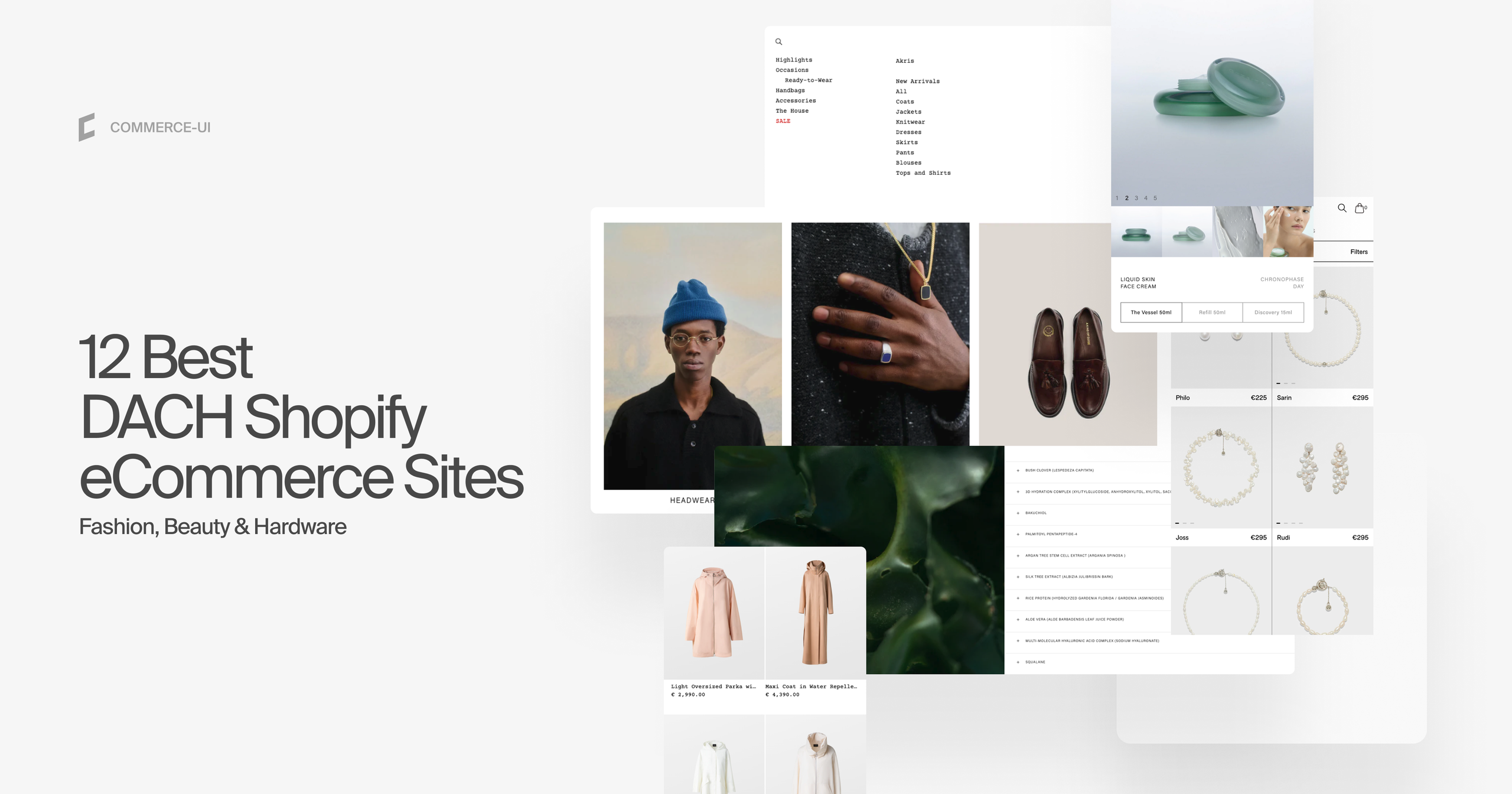
The DACH region is home to a diverse set of eCommerce brands that have elevated their online shopping experiences on Shopify. From heritage fashion houses and modern DTC labels to highly technical brands, these companies show how design, storytelling, and commerce can work together across very different product categories. Below, we explore 12 Shopify stores across fashion, beauty, and hardware with one intentional wild card (non-Shopify) included for its unconventional, brand-led approach to digital commerce. Each example includes a short brand introduction and practical eCommerce insights into what makes the experience effective.

Aeyde
Aeyde is a Berlin-based footwear and accessories brand founded in 2015 by Luisa Dames and Constantin Langholz-Baikousis. The label was born as a digital-first, direct-to-consumer venture with a vision of “understated luxury,” focusing on minimalist design and high-quality craftsmanship. Aeyde’s collection of elegant shoes and accessories reflects German modernist sensibilities – classic shapes with modern details – and the brand has grown from its online origins to be carried by select global retailers.

↑ Aede Home Page and PDP
What stands out:
- Understated, premium site design: The Aeyde website impresses with an understated elegance – clean grid layouts, refined typography, and generous white space create a calm, gallery-like shopping experience. By stripping away unnecessary visual noise, the design keeps attention on product craftsmanship and quality, aligning with the founder’s vision to “democratize modern design and enduring quality” through minimalism. The result is a sophisticated, high-end feel that mirrors Aeyde’s luxury ethos.
- Cohesive branding and content hub: Aeyde’s digital presence feels deliberately cohesive. Neutral colors and editorial-style photography reinforce the brand’s modern yet timeless aesthetic. Beyond commerce, the site functions as a true content hub: an online magazine featuring interviews and editorials, Aeyde Radio with curated mixes, and Aeyde Film, a dedicated space for campaign and brand films. What’s impressive is how seamlessly this content lives alongside the shop — all presented with the same restrained, minimalist design language. The result is a consistent brand system where shopping, storytelling, and cultural content reinforce each other, building a strong lifestyle-oriented narrative around the products rather than treating content as a separate marketing layer.
A Kind of Guise
A Kind of Guise is a Munich-based fashion brand founded in 2009, known for blending global cultural references with precise European craftsmanship. What started as a small project making handmade bags has grown into a menswear label that produces the majority of its collections in Germany and Italy, with a strong focus on quality fabrics, limited runs, and local manufacturing. Each collection is rooted in a specific place or journey, turning garments into narrative objects rather than seasonal trend pieces — a mindset that clearly carries through into how the brand presents itself online.

↑ A Kind of Guise PLP and PDP
What stands out:
- Playful yet refined UX: AKOG’s online store delivers a playful but polished browsing experience. The site uses clean grid layouts and restrained typography, which make the product assortment easy to scan. Subtle hover interactions add a touch of delight – for example, product cards cleverly hide prices until you hover, introducing a small element of discovery without overwhelming the minimalist aesthetic. This thoughtful balance of simplicity and interactivity keeps the focus on the products while still engaging the shopper.
- Editorial product presentation: True to the brand’s storytelling DNA, A Kind of Guise’s site feels part shopping, part editorial. Oversized lookbook images and journal-style entries are woven directly into the browsing experience, so exploring the store feels closer to following a journey than scanning a catalog. What really elevates it is the brand’s distinctive art direction, which leans into a reportage-style approach: immersive photography blended with subtle video sequences that document places, people, and movement rather than staged fashion moments. A standout example is the “Mongolian Horse Riding” story, where garments are presented through documentary-like visuals that feel raw, authentic, and culturally grounded. Importantly, products are embedded directly within these stories in a non-intrusive way — quietly shoppable, context-aware, and never interrupting the narrative flow. Combined with occasional monospace typography (evoking archival or travel notes) and generous whitespace, the interface remains calm and design-led, allowing AKOG’s craftsmanship and global influences to take center stage.
Akris
Akris is a Swiss luxury fashion house founded in 1922 in St. Gallen by Alice Kriemler-Schoch. Still run by the Kriemler family today (third-generation creative director Albert Kriemler at the helm), Akris is renowned for its refined women’s apparel, sleek horsehair handbags, and signature St. Gallen embroidery fabrics. As one of the last independent high-fashion houses, Akris embodies an elegant, understated design philosophy that blends heritage with innovation.

↑ Akris Home Page, PLP and PDP
What stands out:
- Editorial-first luxury commerce: Akris’s digital experience is built around the idea that fashion storytelling should lead, with commerce following naturally. The site features editorial-driven content pages that document runway shows, behind-the-scenes moments, and collection narratives, giving the brand a dedicated space to express its creative vision beyond seasonal product drops. These pages feel closer to a digital fashion archive than a traditional brand blog, reinforcing Akris’s heritage and design-led positioning while keeping users engaged for longer sessions.
- Shoppable lookbooks that bridge inspiration and conversion: The brand excels at turning inspiration into action through immersive, shoppable lookbooks. Full-width campaign imagery is paired with intuitive navigation, allowing users to explore collections in a visual-first slider format. Products can be added directly to the cart from within the lookbook, removing friction and collapsing the gap between editorial browsing and purchasing. It’s a strong example of how luxury brands can remain image-led without sacrificing conversion.
- Dynamic, editorialized PLPs: Rather than relying solely on standard product grids, Akris introduces editorial content blocks directly into Product Listing Pages. Campaign visuals and lifestyle imagery are interspersed with products, subtly guiding attention toward key categories or seasonal highlights. This breaks the monotony of endless grids and encourages deeper exploration, making browsing feel more fluid and lifestyle-oriented while preserving clarity and usability.
- Modular mega navigation with storytelling hooks: Akris’s modular mega navigation is designed to scale across a wide product range without overwhelming the user. Beyond clean category structures, it includes flexible content slots for banners and editorial placements. This allows the brand to surface upcoming runway shows, capsule collections, or high-margin categories directly within navigation — turning the menu itself into a storytelling and merchandising surface rather than a purely functional tool.
Disclosure: We had the privilege of working closely with the Akris team on the digital design. Read the full case study
Carhartt WIP
https://us.carhartt-wip.com/en-us/
Carhartt Work In Progress (WIP) is the European streetwear offshoot of the iconic American workwear brand Carhartt. Established in 1994 by Swiss entrepreneur Edwin Faeh, Carhartt WIP develops its own collections based on the classic Carhartt workwear, reinterpreted for a new context. Over the past decades, WIP has grown into a global brand with 80+ stores worldwide, known for blending the rugged authenticity of its Detroit heritage with the influences of European skate, graffiti, and music subcultures.

↑ Carhartt-WIP Home Page, PLP and PDP
What stands out:
- Cinematic lifestyle imagery: Carhartt WIP’s online store leans heavily on lifestyle content to showcase products in context. The creative direction is almost cinematic – lookbooks and homepage visuals feature people in motion, on city streets or at work, wearing WIP gear in real environments. This narrative approach makes the clothes feel like part of a real wardrobe rather than isolated studio products. For example, jackets and work pants are shown on skateboarders or artists, reinforcing Carhartt WIP’s credibility in subculture scenes while also highlighting product functionality. The overall vibe is gritty yet authentic, which resonates with the brand’s urban audience.
- Editorial meets commerce: The site blurs the line between an editorial blog and an e-commerce catalog. It includes sections for editorials, lookbooks, and even an online magazine that delves into collaborations or cultural projects, all accessible alongside the shopping sections. This content-driven approach keeps fans engaged and reflects Carhartt WIP’s roots in music, art, and skate communities. From a UI perspective, the navigation is segmented cleanly (e.g., Men, Women, Collections, Editorial, Magazine), making it easy to either shop products or explore stories. The design stays utilitarian (a nod to workwear), using simple fonts and a straightforward layout, but with rich media and articles that add depth to the brand experience.
Disclosure: We developed a new Shopify website for Carhartt WIP North America. Read full case study
Snocks
SNOCKS is a German direct-to-consumer basics brand, founded in 2016 and headquartered in Mannheim. Started by cousins Johannes Kliesch and Felix Bauer by selling sneaker socks on Amazon, Snocks quickly grew into a leading D2C label in the DACH region for everyday essentials. The company offers a range of affordable, high-quality basics like socks, underwear, and loungewear, and is known for its no-nonsense, functionality-first approach.

↑ Snocks Home Page, PLP and PDP
What stands out:
- “Fast add” shopping grid: Snocks’s online store is optimized for efficiency. Product listing pages show items with pack size and price upfront, and even include Add-to-Cart buttons right on the product cards. For example, on the Snocks homepage, a best-seller like “Sneaker Socken – Weiß” is labeled as “6 Paar 32,99€” (6 pairs for €32.99) and can be added directly to the cart without leaving the page. This grid design – displaying whether it’s a 2-pack, 3-pack, or 6-pack (“Stück” or “Paar”) and allowing one-click adding – makes the shopping experience feel quick and utilitarian, perfectly fitting a basics brand. Despite the focus on utility, the grid remains clean and visually tidy, using consistent product thumbnails and concise text.
- Built-in volume discounts and bundles on PDPs: Snocks excels at encouraging larger purchases with transparent bulk pricing and bundle-first logic on its product pages. Each PDP allows customers to select predefined quantity bundles (often 6, 12, or 18 units for socks), with savings clearly indicated and updated in real time. For example, choosing a 12-pair bundle triggers a message like “Spare 10%,” while 18 pairs unlocks “Spare 15%,” alongside a clear price breakdown. The interface shows both the original and discounted prices, so the incentive to buy more is immediately visible. By combining bundles with tiered volume discounts — all surfaced directly within the PDP — Snocks turns quantity selection into a simple value decision rather than an upsell tactic. This approach, powered by Shopify Discounts, has been instrumental in increasing average order value while keeping the experience transparent and user-friendly.
- Local language and community feel: Snocks localizes its site for German (and other languages) in a friendly tone. The copywriting on buttons and banners (e.g., references to “Anti-Loch Garantie” for sock hole guarantee, or warm phrases like “Gute Wahl! 👍” after adding to cart ) gives a conversational, almost casual vibe. Combined with touches like highlighting that it’s a family-run startup from Mannheim, founded in 2016 (mentioned on the site ), Snocks’s e-commerce presence manages to feel approachable and community-driven, even as it implements slick D2C growth tactics.
- Functional navigation with visual cues: The side navigation enhanced with small iconography is a subtle but effective UX detail. Icons help users quickly distinguish between categories such as socks, underwear, or accessories, improving orientation and reducing cognitive load in a catalog-heavy environment.
Gezeiten
Gezeiten is a high-end skincare brand from Germany that merges marine biotechnology with luxury beauty. Co-founded by husband and wife Michaela and Michael Hiltebrandt (with creative direction by siblings Claire and Charles Bals), Gezeiten launched in 2023 with a mission to develop chronobiology-driven skincare. The very name “Gezeiten” means “tides” in German, reflecting the brand’s concept of products that work in sync with the body’s day/night rhythms. All formulations are made in Germany, and the brand emphasizes sustainability (refillable packaging, natural marine ingredients) alongside cutting-edge science.

↑ Gezeiten Home Page, PLP and PDP
What stands out:
- Product as hero – packaging & design: Gezeiten’s website makes its packaging part of the product story. The signature green glass jar (called The Vessel) isn’t just shown as a container; it’s consistently photographed like a hero object – often against artistic backdrops of coral or flowing water – to underscore the brand’s fusion of science and nature. This approach gives the site a very premium, editorial feel (more akin to a design magazine than a typical skincare shop). Every detail, from the minimalist layout to the oceanic imagery, creates what the brand calls a “cinematic, otherworldly visual language” that conveys calm, depth, and a connection to nature. Browsing the Gezeiten site feels like entering a serene, science-meets-art wellness world, which differentiates it strongly from conventional beauty e-commerce.
- Day vs. Night shopping cues: A clever UI touch on Gezeiten’s Shopify store is how it denotes products meant for daytime versus nighttime use. On listing pages, each product tile includes a small label or background hue indicating its Chrono-Phase (Day, Night, or both). For example, the day creams might appear over a lighter, sunrise-tinted gradient, whereas the night formulas have a darker, duskier background. This subtle visual cue lets shoppers immediately distinguish day vs. night products at a glance, without needing to read detailed labels or use a filter. It’s an intuitive design choice that reinforces Gezeiten’s core concept of circadian-rhythm skincare. Even the product names and descriptions emphasize this (“FACE CREAM ∙ DAY” vs. “FACE CREAM ∙ NIGHT”), and the site’s filter allows browsing by Chrono-Phase. Overall, it’s a unique way to streamline product selection while highlighting the brand’s scientific angle.
- Education and ritual-building: Given the novel nature of Gezeiten’s biotech approach, the site also doubles as an educational platform. The “Our Approach” and “Chronobiology Method” sections explain the science in accessible terms, and PDPs (Product Detail Pages) often include numbered benefits and usage instructions. The online store encourages a ritualistic mindset – e.g., selling Day & Night sets and explaining how using both yields optimal results. By guiding users to see skincare as a cycle (day protection + night regeneration), Gezeiten not only sells products but also an entire philosophy of use. This content is presented in a clean, digestible way, complementing the shopping experience without overwhelming it.
Auteur
Auteur is a German luxury skincare brand that launched around 2020, positioning itself at the ultra-premium end of the market. Developed and produced in Germany, Auteur prides itself on “high-active” formulations – each product contains a cocktail of 100+ active ingredients (peptides, growth factors, antioxidants, etc.) for clinically effective results. Sustainability is also emphasized with refillable packaging and responsibly sourced ingredients. The brand’s philosophy is to elevate skincare to an art form, blending advanced biotechnology with refined design and craftsmanship.

↑ Auteur Home Page, PLP and PDP
What stands out:
- Immersive product presentation: Auteur’s website makes a striking first impression by turning its product presentation into a highly visual, gallery-like experience. Instead of relying on conventional catalog layouts, the brand leans heavily into large-scale, ultra-high-quality imagery — often dramatic close-ups of the bottle or product texture — that dominate the screen and read almost like a modern art exhibit. This image-led approach establishes a strong sense of luxury and restraint from the first interaction, setting the tone before the user even engages with product details.
- Information-rich, yet elegant PDPs: Auteur’s Product Detail Pages combine this visual confidence with a carefully structured, information-rich layout. The sculptural packaging (sleek black and brown glass) is treated as a central design element, while ingredient storytelling is elevated through elegant visual compositions that highlight key actives. These are often paired with 3D render videos of the packaging, adding subtle motion and reinforcing the brand’s scientific precision. Key benefits are presented as numbered points in a clean column, allowing users to quickly grasp the value proposition, while sections for ingredients, usage, and scientific background are clearly separated and generously spaced to avoid cognitive overload. A prominently placed product-matching quiz in the navigation supports guided selling, offering personalized recommendations without disrupting the refined flow. Together, these PDPs demonstrate how luxury, education, and conversion can coexist seamlessly within a Shopify Plus experience.
- Consistent luxury branding: From typography to color scheme, the Auteur site maintains a consistently elevated tone. It uses a modern serif font and a minimalist black/white/gold palette, exuding elegance. Interactive elements (like menu hover states or the quiz flow) are smooth and refined. The site also leverages storytelling in spots – for instance, an About page or lookbook that explains the brand’s origin and philosophy of “sensory minimalism” in design and “uncompromising quality and innovation”. All these details reinforce Auteur’s positioning as not just a skincare line, but a luxury experience — which is crucial when you’re selling products in the €300+ range.
Gitti
https://www.gitticonsciousbeauty.com/en-eu
Gitti is a Berlin-based “conscious beauty” brand founded by Jennifer Baum-Minkus, aimed at revolutionizing the beauty industry with sustainable, innovative products. Launched in 2019, Gitti made a name with its vegan, non-toxic nail polishes and has since expanded into makeup and skincare. The brand’s mission is to create products that are better for people and the planet – from plant-based formulas to eco-friendly packaging – and to promote a holistic, routine-based approach to beauty. Gitti has a passionate community (often engaging with #gittigang on social media) and is known for its bold, playful branding.

↑ Gitti Home Page, PLP and PDP
What stands out:
- Routine-oriented shopping: Gitti’s eCommerce experience is built around selling routines rather than single products. Instead of leaving customers to assemble combinations on their own, the site highlights complete systems like the “Discovery Kit” or the “Nail Recovery Treatment – 3-step care routine,” bundling base, color, and top coat together. This approach reduces decision fatigue, increases cart value, and positions Gitti as a solution provider for nail care and beauty routines rather than a seller of standalone items. Navigation and PDPs reinforce this logic with dedicated “3-step care routine” sections and contextual reminders to complete the set.
- Guided how-to modules on PDPs: Gitti’s Product Detail Pages feature embedded step-by-step application modules that explain how to use each product in context. The “Infinite Gloss Routine,” for example, walks users through Base, Color, and Seal with short instructions and visuals. These tutorial-style components educate users directly at the point of purchase while subtly upselling complementary products — a strong example of content and commerce working together.
- Community and values front and center: The site’s bright colors, playful graphics, and positive tone reflect Gitti’s eco-conscious, community-driven identity. Clear badges highlight attributes like vegan, cruelty-free, and clean formulations, while the About section emphasizes sustainability commitments such as carbon neutrality and circular thinking. Reviews, user-generated content, and empowering product naming reinforce trust and make the shopping experience feel more like joining a movement than completing a transaction.
Lupine Lights
https://www.lupinelights.com/en
Lupine Lights is a German performance-lighting manufacturer with over 30 years of experience building ultra-high-end lighting systems for climbers, mountain bikers, rescue teams, and outdoor professionals. Their products are engineered for extreme conditions — storms, avalanches, and environments where failure is not an option.

↑ Lupine Home Page, PLP and PDP
What stands out:
- Designing with darkness as the interface: The visual system flips a core assumption: darkness becomes the canvas, light becomes the product. Cinematic photography, deep contrasts, and modular editorial layouts allow Lupine’s lights to perform visually the same way they do in real life. Features like the “Shine On” toggle let users compare real illumination scenarios with standard imagery — a powerful, show-don’t-tell interaction.
- Configurator-driven commerce: Lupine’s Shopify-native configurator allows customers to assemble complete lighting systems based on activity, compatibility, and environment. These are not fake bundles, but real SKUs with live inventory, pricing logic, and regional constraints. Eight distinct configuration paths, dynamic validation, and instant feedback all happen without a custom backend.
- B2B as a first-class experience: Lupine’s professional customers — retailers, athletes, rescue organizations — operate inside the same unified catalog as B2C users. Shopify’s B2B features are extended through automation and segmentation, enabling role-based pricing, gated products, documentation access, and region-specific compliance (including real-time StVZO restrictions). B2B doesn’t feel bolted on; it feels native.
Tado
Tado° is a Munich-based smart climate brand founded in 2011, best known for its connected thermostats and AC controllers designed to reduce energy consumption through intelligent automation. Operating at the intersection of sustainability, engineering, and consumer tech, Tado° has become one of Europe’s most recognizable smart-home brands.

↑ Tado Home Page and PDP
What stands out:
- Calm, confidence-driven commerce: Tado°’s eCommerce experience reflects the brand’s product philosophy: quiet, precise, and purpose-built. The interface avoids flashy interaction in favor of clarity, using restrained typography, soft contrasts, and structured layouts that feel trustworthy and technical rather than lifestyle-driven. This is a store designed to reassure, not to entertain.
- Education-led PDPs: Product Detail Pages focus heavily on explaining value through logic, not hype. Clear diagrams, compatibility explanations, and feature breakdowns help users understand how each device fits into their home setup. Rather than overwhelming visitors with specs, information is layered progressively — ideal for products that require a degree of technical confidence before purchase.
- Systems thinking over single products: Tado° consistently frames its offering as a connected system, not isolated devices. Bundles, ecosystem messaging, and upgrade paths are surfaced throughout the journey, encouraging users to think in terms of long-term energy optimization rather than one-off purchases. It’s a strong example of how smart-home brands can guide users toward more complex setups without friction.
GmbH
This one is not a Shopify store, but I couldn’t resist adding them here.
GmbH is an experimental fashion label based in Berlin, founded in 2016 by Serhat Isik and Benjamin Alexander Huseby. Named after the German abbreviation for a limited company, the brand has quickly gained critical acclaim for its underground, club-inspired aesthetic, inclusive ethos, and political engagement. Its designs blend techno, streetwear, and high fashion, often using upcycled materials and bold silhouettes — positioning GmbH as much as a cultural project as a clothing brand.

↑ GmbH Home Page and PDP
What stands out:
- Deliberately retro web design: GmbH’s online store intentionally rejects modern e-commerce conventions, leaning into a raw, early-2000s web aesthetic. The interface feels closer to a stripped-down forum or web directory, with plain text menus, ASCII-style graphics, and deliberately clunky navigation. In an era of polished DTC templates, this lo-fi approach acts as a filter: it instantly signals subcultural credibility and turns the website itself into an artistic statement rooted in ’90s Berlin club culture and Y2K internet references.
- The anti-ecommerce vibe (that still sells clothes): Despite its unconventional UI, the site remains fully shoppable. Product listings are basic, almost austere, but this lack of polish creates a sense of authenticity and exclusivity — as if you’ve stumbled into an underground marketplace. The experience is intentionally frictional, yet functional, proving that e-commerce doesn’t have to look “premium” to convert when it resonates deeply with its audience. In fact, the unexpected design often becomes a talking point, driving organic word-of-mouth.
- Community and cultural resonance: GmbH’s values are embedded directly into the digital experience. The no-frills design prioritizes content over decoration, mirroring how the brand uses fashion as a vehicle for cultural commentary. Practical elements like direct links to stockists and a clearly accessible Impressum reinforce transparency. Altogether, the site feels less like a shop and more like an invitation into a subculture — a risk that pays off in memorability, authenticity, and strong community alignment.


By signing up, you are agreeing to our privacy policy


